

PICO PERFECT
At Halo Clinic, pico laser is not performed using the same standard settings for every patient. Each treatment is personally assessed and planned by Dr Delong Zeng according to the nature and depth of your pigmentation, your skin sensitivity, previous treatments and how your skin responds over time.
What distinguishes our approach is not simply the laser technology, but the depth of dermatology experience guiding its use. Dr Zeng spent eight years working closely alongside one of Singapore’s leading private dermatologists, gaining extensive hands-on clinical experience in the management of pigmentation, acne, scarring and complex skin conditions. This professional collaboration continues today.
What Is Pico Laser?
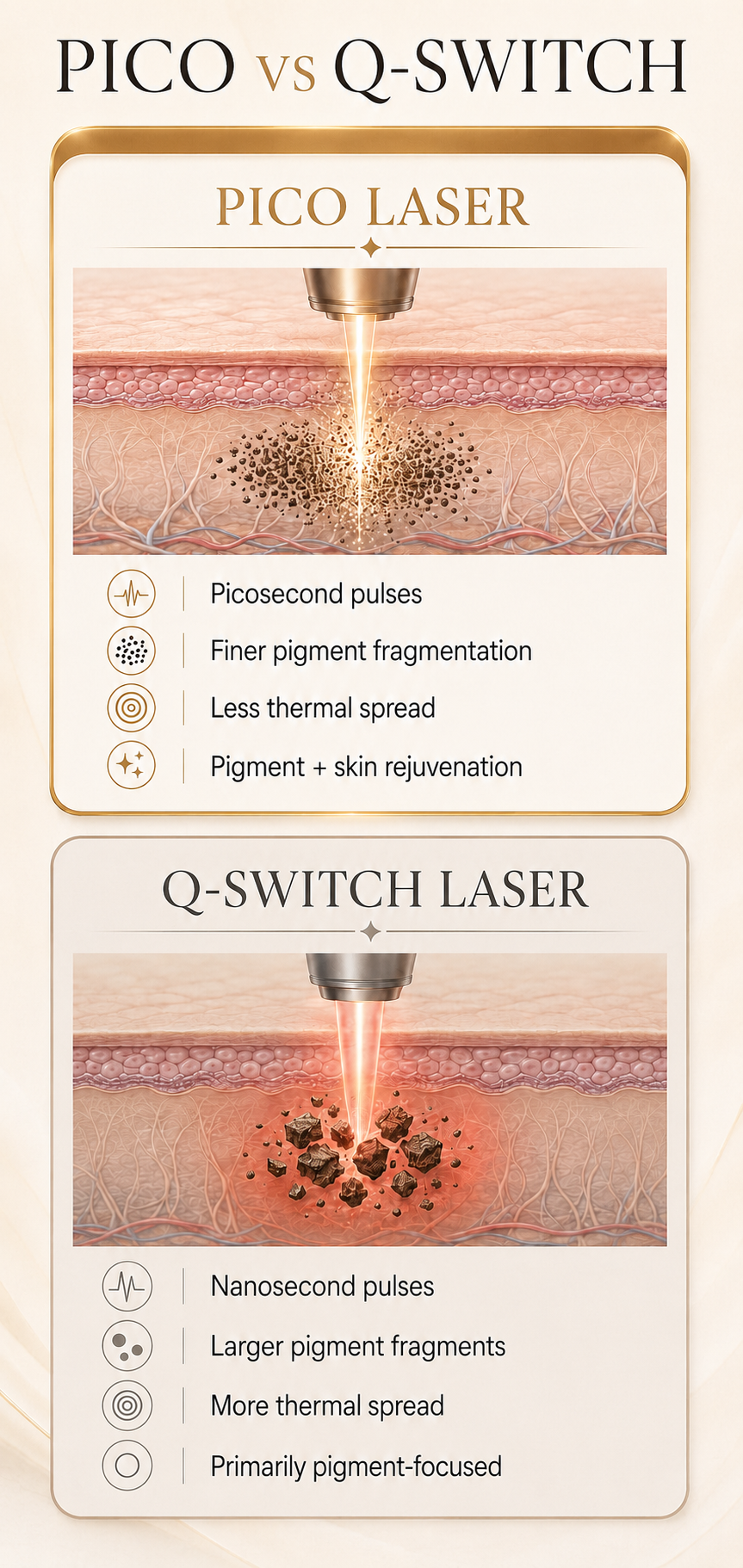
Pico laser delivers energy in extremely short picosecond pulses. These rapid pulses create a photoacoustic effect that shatters unwanted pigment into smaller particles, allowing the body to gradually clear them through its natural processes.
Because the energy is delivered very quickly, pico laser can target concentrated pigment while limiting unnecessary heat exposure to the surrounding skin. It can also create controlled stimulation within the skin to support collagen remodelling and improve the appearance of pores, texture and superficial acne scars.
However, the effectiveness and safety of pico laser depend on much more than how advanced the machine is. The doctor must first understand what is causing the pigmentation, where it is situated within the skin and how it is likely to respond to treatment.
What Can Pico Laser Treat?
Pico laser may be used to improve:
Sun spots and freckles
Uneven skin tone
Post-inflammatory hyperpigmentation
Pigmentation left behind after acne
Dull or tired-looking skin
Melasma as part of a carefully managed treatment plan
Enlarged pores
Uneven skin texture
Superficial acne scars
Certain tattoos and unwanted cosmetic pigment
Not all pigmentation behaves in the same way. Freckles, sun spots, acne marks, melasma and other pigmentary conditions can sometimes appear similar, but they may respond very differently to laser treatment. An accurate assessment is therefore essential before deciding whether pico laser is appropriate.
One of the Most Advanced Pico Lasers on the Market
Not all pico laser systems are made equal. Halo Clinic uses one of the newest pico laser platforms on the market, developed with one of the highest levels of research and development investment behind the technology.
Strong R&D matters because it shapes every aspect of the technology, from the stability of each laser pulse and the precision of energy delivery to the reliability of its wavelengths, handpieces and treatment modes. This allows pigment to be fragmented more effectively while reducing unnecessary heat exposure to the surrounding skin.
Its advanced engineering allows energy to be delivered with greater power, precision and consistency. This produces a stronger photoacoustic effect for more effective pigment fragmentation, while maintaining stable energy delivery from pulse to pulse. Multiple wavelengths and treatment modes also allow different depths of pigmentation, acne marks, pores and skin texture to be treated more comprehensively.
When combined with Dr Delong Zeng’s extensive dermatology experience, this advanced platform allows treatments to be customised with greater precision and consistency. The result is not simply a more powerful pico laser, but a more refined and reliable treatment system designed to deliver clearer, more predictable results.
Multiple Wavelengths for Different Skin Concerns
Pigmentation can exist at different depths within the skin. A single wavelength or setting may not be suitable for every concern.
Our pico laser system offers multiple wavelengths that can be selected according to the colour, depth and nature of the pigment. During the same treatment session, Dr Zeng may use different wavelengths, handpieces and treatment modes where appropriate to address different layers of the skin.
This allows superficial pigmentation, deeper pigment, acne marks and overall skin quality to be approached more comprehensively. The treatment is adjusted to the individual rather than following a predetermined protocol.
Pico Laser for Pigmentation
Brown spots and uneven pigmentation can develop because of sun exposure, inflammation, hormonal influences, genetics and the natural ageing process.
Pico laser breaks concentrated pigment into smaller fragments while preserving the surrounding skin as much as possible. These particles are then gradually cleared by the body, allowing treated areas to appear lighter and the complexion to become more even over time.
Results are usually progressive rather than immediate. Superficial spots may respond relatively quickly, while deeper or more diffuse pigmentation may require several sessions. Some conditions may also recur because the underlying tendency to develop pigmentation remains.
The objective is not necessarily to use the strongest possible laser setting. Appropriate treatment requires balancing effective pigment clearance with the risk of excessive inflammation, rebound pigmentation and unnecessary downtime.
Pico Laser for Melasma
Melasma is a complex and recurrent pigmentary condition influenced by factors such as sunlight, heat, hormones, inflammation and genetics. It should not be treated in the same way as an isolated sun spot or freckle.
Pico laser may form part of a broader melasma-management programme, but overly aggressive treatment can sometimes worsen the condition. Conservative settings, appropriate skincare, consistent sun protection and careful monitoring are therefore particularly important.
At Halo Clinic, melasma is approached as a condition requiring long-term management rather than a problem that can always be permanently removed with a single laser session.
Pico Laser for Acne Marks and Scars
After active acne settles, the skin may be left with brown marks, uneven pigmentation, enlarged pores or textural irregularities. Pico laser can target residual pigment while also creating controlled stimulation within the skin to support gradual remodelling.
This can help acne marks fade more evenly while improving the overall appearance of skin texture and pores. However, acne marks and acne scars are not the same. Pigmentation may respond to laser, while deeper indented scars often require treatment at a different level of the skin.
Depending on the type of scarring, Dr Zeng may recommend combining pico laser with microneedling, skin boosters, exosomes or other scar-management treatments. The aim is not simply to apply a laser to every scar, but to identify which layer and component of the scar needs to be treated.
Pico Laser for Skin Rejuvenation
Pico laser can also be used when there is no single prominent pigmentation concern. Gentle treatment may help improve overall luminosity, refine the appearance of pores and create a smoother, brighter and more even-looking complexion.
For patients experiencing dullness, mild uneven tone or early textural changes, pico laser may form part of a longer-term skin-maintenance programme. Treatment intensity and frequency can be adjusted according to the skin’s response and the patient’s goals.
Dermatology Experience That Shapes Every Treatment
Pico laser results depend on more than the technology being used. The doctor must be able to distinguish between different pigmentary conditions, understand how they behave and recognise when laser treatment could potentially make the problem worse.
Dr Delong Zeng spent over eight years working closely alongside one of Singapore’s leading private dermatologists, managing a wide range of pigmentation, acne, scarring and complex skin conditions in everyday clinical practice. This was not a short course or occasional observership. It was prolonged, hands-on experience developed through years of assessing patients, planning treatments, monitoring their progress and observing how different skin conditions respond over time. This professional collaboration continues today.
Such sustained clinical mentorship within an established private dermatology practice is uncommon among aesthetic doctors. It gave Dr Zeng exposure not only to straightforward cosmetic concerns, but also to recurrent, resistant and more complicated skin conditions.
More importantly, this experience developed the clinical judgement to recognise when pigmentation should be treated with laser, when conservative settings are necessary and when laser may not be the most appropriate first treatment.
This is particularly important when treating Asian skin, which may be more susceptible to post-inflammatory hyperpigmentation. Conditions that appear similar can behave very differently after laser exposure. Applying the same settings to every patient may lead to inconsistent results, unnecessary inflammation or worsening pigmentation.
At Halo Clinic, every pico laser treatment therefore begins with an individual assessment. Wavelengths, treatment modes and energy settings are selected according to the nature and depth of the concern, the patient’s skin type, previous treatments and response to each session.
The aim is not simply to deliver stronger laser energy. It is to make informed treatment decisions, use an appropriate intensity and progressively improve the skin while minimising unnecessary inflammation and the risk of rebound pigmentation.
What Happens During a Pico Laser Treatment?
Your skin will first be cleansed and assessed. Protective eyewear will be provided before the treatment begins.
Topical numbing will also be applied where appropriate.
During treatment, you may feel a light snapping, tingling or warming sensation as the laser energy is delivered. Different wavelengths, handpieces or settings may be used across different areas depending on the concerns being addressed.
A typical session takes approximately 20 to 30 minutes, although the duration may vary according to the treatment area, the number of treatment modes used and the complexity of the skin condition.
Is There Any Downtime?
Downtime depends on the intensity of treatment and the condition being addressed.
After a gentle rejuvenation session, the skin may appear mildly pink or feel warm for several hours. When individual pigment spots are treated more intensively, they may temporarily darken or develop light crusting before gradually fading.
Most patients can return to their usual activities shortly after treatment. Sun protection and appropriate aftercare are particularly important when treating pigmentation. Patients should also avoid picking or scratching any treated areas while the skin is recovering.
How Many Sessions Will I Need?
The number of sessions required depends on the nature, depth and severity of the concern.
Some superficial pigment may improve after a small number of treatments. Diffuse pigmentation, melasma, acne marks and textural concerns commonly require a planned series of sessions. Maintenance treatment may also be recommended because new pigmentation can develop with continued sun exposure, hormonal changes, inflammation and ageing.
Your results will be reviewed progressively. Settings may be adjusted according to how your skin responds rather than exposing it to unnecessarily aggressive treatment from the beginning.
Combination Treatments
Pico laser can be combined with other treatments when pigmentation is only one part of the overall concern.
Depending on your skin, a personalised programme may include:
Skin boosters to improve hydration and overall skin quality
Microneedling for acne scars and textural irregularities
Exosome treatments to support skin recovery
BBL for broader photorejuvenation involving both redness and pigmentation
Medical-grade skincare and consistent sun protection
Combination treatment is recommended only when it provides a meaningful advantage. Not every patient requires multiple procedures, and the sequence and timing of treatment should be planned carefully to avoid unnecessary skin irritation.
Why Choose Halo Clinic for Pico Laser?
What distinguishes Halo Clinic is not the pico laser machine alone, but the clinical experience guiding its use.
Dr Zeng combines his background in plastic and general surgery with over eight years of close clinical mentorship under a leading private dermatologist. This gives him an unusually broad understanding of facial anatomy, pigmentation, acne, scarring, skin sensitivity and aesthetic treatment planning.
Every pico laser treatment is personally assessed and planned with attention to:
Identifying the likely type of pigmentation before treatment
Selecting suitable wavelengths for pigment at different depths
Adjusting settings for Asian and pigmentation-prone skin
Recognising when laser should be used conservatively or avoided
Monitoring the skin’s response before increasing treatment intensity
Combining pico laser with skincare or other procedures only when beneficial
Managing recurrent pigmentation as a long-term condition rather than promising a quick cure
Pico laser is treated as a precise medical tool rather than a standardised facial. Our goal is to help your skin appear clearer, brighter, smoother and more even through careful assessment, appropriate treatment and considered long-term management.
FAQ
Is pico laser suitable for all skin types?
Pico laser can be used across a wide range of skin types, but the wavelength, energy and treatment approach must be selected carefully. Patients with darker or pigmentation-prone skin may require more conservative settings to reduce the risk of post-inflammatory hyperpigmentation.
Is pico laser painful?
Most patients describe the sensation as light snapping, tingling or warmth. Comfort levels vary according to the treatment area and intensity. Any necessary comfort measures can be discussed before treatment.
Will my pigmentation disappear after one session?
Some superficial spots may improve relatively quickly, but most pigmentation concerns require a series of treatments. Melasma and recurrent pigmentation usually require ongoing management rather than a one-time cure.
Can pico laser make pigmentation worse?
Any laser treatment can potentially cause temporary darkening or post-inflammatory hyperpigmentation, particularly in sensitive or pigmentation-prone skin. Certain conditions, including melasma, can also worsen if treated too aggressively. Careful assessment, appropriate settings, aftercare and sun protection help reduce these risks.
What is the difference between pico laser and BBL?
Pico laser delivers ultra-short pulses to target concentrated pigment and stimulate controlled skin remodelling. BBL uses broad-spectrum light and can address a broader range of colours, including brown pigmentation and redness.
The more appropriate treatment depends on the cause, colour and depth of the concern. In some cases, the two technologies may be used as part of a combined treatment plan.
Can pico laser treat melasma?
Pico laser may form part of a melasma-management programme, but melasma is complex and frequently recurrent. Aggressive laser treatment can sometimes worsen it. Treatment should therefore be conservative and supported by appropriate skincare, sun protection and management of contributing triggers.
Can pico laser improve acne scars?
Pico laser may improve pigmentation, enlarged pores and mild textural irregularities associated with acne. Deeper or more established scars often respond better to a combination of treatments rather than pico laser alone.
Is there any downtime after treatment?
Gentle treatment may cause mild redness or warmth for several hours. More intensive treatment of individual pigment spots may cause temporary darkening or light crusting. The expected recovery will depend on the condition being treated and the settings used.
How soon can I apply makeup?
Makeup can usually be applied after any immediate redness or sensitivity has settled, provided the skin surface remains intact. More intensive spot treatments may require additional recovery time.
How long will the results last?
Treated pigment may gradually lighten, but new pigmentation can develop because of sun exposure, hormonal changes, inflammation and ageing. Consistent sun protection, suitable skincare and maintenance treatments can help preserve the improvement.
Book a consultation for a personalised skin assessment and pico laser treatment plan tailored to your concerns.