


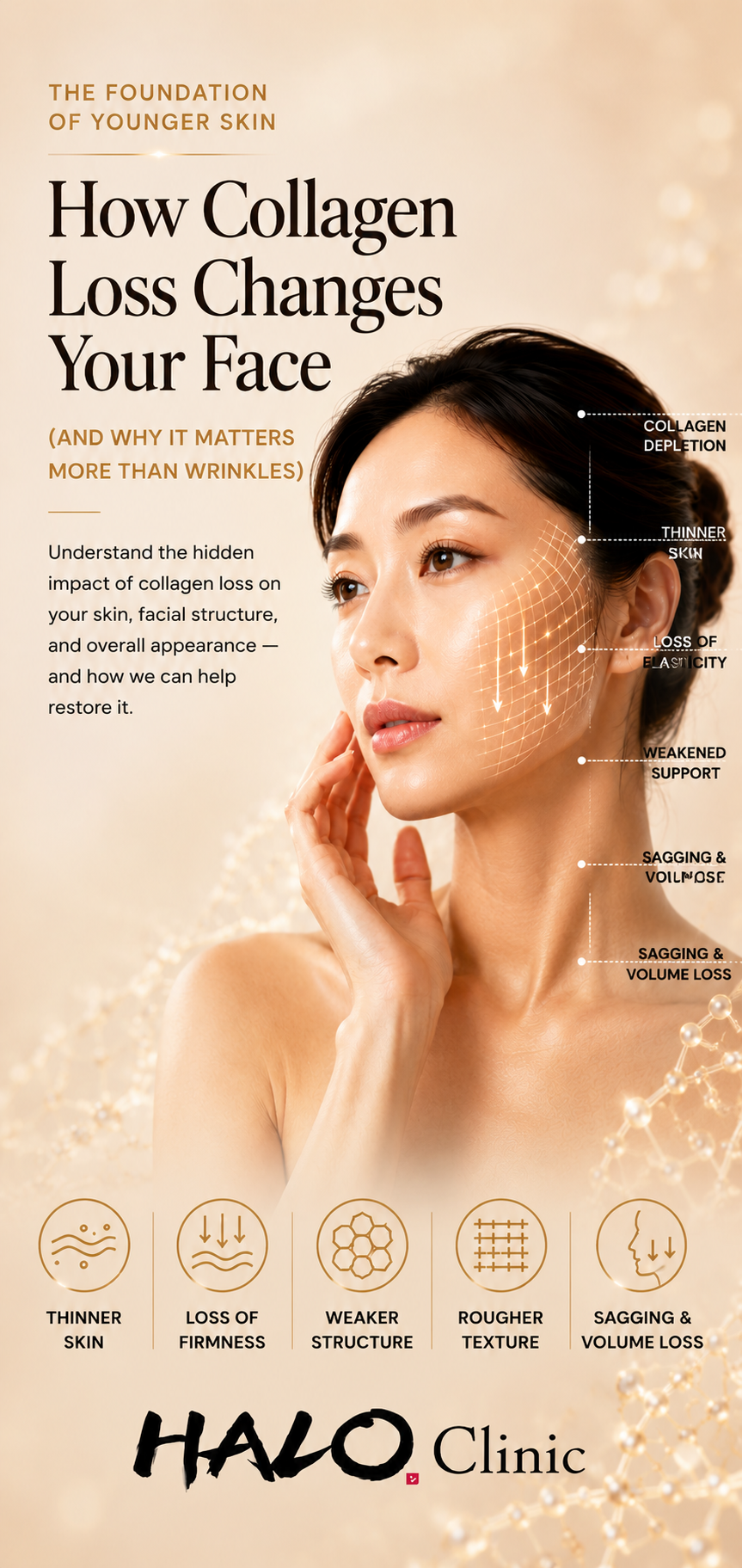
How Collagen Loss Changes Your Face (And Why It Matters More Than Wrinkles)
When most people think about ageing, they think about wrinkles.
In reality, wrinkles are only one visible sign of a much bigger process happening beneath the skin. One of the most important changes is the gradual loss of collagen.
Collagen acts as the skin's natural support framework. As we produce less collagen over time, the skin becomes thinner, weaker, and less able to resist gravity. This contributes not only to wrinkles, but also to sagging, volume loss, enlarged pores, and changes in skin texture.
Understanding collagen loss helps explain why many modern aesthetic treatments focus on stimulating your body's own collagen rather than simply filling lines.
What Is Collagen?
Collagen is the most abundant protein in the human body. It provides strength, structure, and elasticity to the skin while supporting the deeper tissues of the face.
Healthy collagen allows the skin to remain:
Firm
Smooth
Elastic
Hydrated
Resilient
When we are young, our body continually produces new collagen to replace old collagen. This natural repair process slows down as we age.
When Do We Start Losing Collagen?
Collagen production begins to decline from our mid-twenties. Most people lose approximately 1% of their collagen each year, and the process accelerates after menopause in women and with continued sun exposure, smoking, and environmental damage.
While this gradual decline may not be obvious at first, the cumulative effects become increasingly noticeable over time.
How Collagen Loss Changes Your Face
As collagen decreases, the skin gradually loses its ability to support itself.
This can lead to:
Fine lines becoming deeper
Skin becoming thinner
Reduced skin elasticity
Larger visible pores
Rougher skin texture
Less skin hydration
Slower wound healing
Loss of firmness
Mild facial sagging
Many patients assume these changes happen suddenly, but they often develop gradually over many years.
Collagen Loss Is Different From Volume Loss
One common misconception is that collagen loss and volume loss are the same thing. They are actually different processes.
Collagen loss affects the quality and strength of the skin.
Volume loss occurs when fat pads shrink or descend, changing the overall shape of the face.
Both contribute to ageing, but they require different treatment strategies. This is why an experienced doctor assesses every layer of the face before recommending treatment.
Can We Replace Lost Collagen?
Unfortunately, applying collagen creams does not replace collagen inside the skin.
Collagen molecules are too large to penetrate deeply enough to rebuild the skin's supporting framework.
Instead, modern treatments aim to stimulate your own fibroblasts, the specialised cells responsible for producing collagen. These treatments encourage the skin to gradually rebuild itself from within, producing natural-looking improvements over time.
Treatments That Stimulate Collagen
Different treatments stimulate collagen in different ways. Some focus on improving skin quality, while others provide lifting or structural support.
Depending on your skin concerns, collagen-stimulating treatments may include:
Biostimulators
Skin boosters
Microneedling
Exosome-assisted skin rejuvenation
HIFU
Radiofrequency treatments
Laser treatments
Each treatment has its own role, and not every option is suitable for every patient.
Why More Collagen Doesn't Always Mean Better Results
Many people focus solely on increasing collagen production. However, collagen stimulation is only one part of facial rejuvenation.
If the underlying problem is volume loss, weakened ligaments, or bone changes, collagen stimulation alone may not produce the desired lifting effect.
Natural-looking rejuvenation comes from correctly identifying the cause of ageing and selecting the appropriate treatment, or combination of treatments to address it.
How We Restore Collagen at Halo Clinic
At Halo Clinic, collagen stimulation is never approached as a one-size-fits-all treatment.
Dr Delong Zeng combines over 10 years of clinical experience with extensive training in Plastic Surgery, General Surgery, and Dermatology to assess not only how much collagen has been lost, but also where it has been lost and which layers of the face require treatment.
Depending on your skin condition and aesthetic goals, your personalised treatment plan may include skin boosters, collagen-stimulating injectables, HIFU, microneedling, exosomes, or other regenerative treatments. The aim is not simply to produce more collagen, but to restore healthier, stronger skin while maintaining natural facial proportions.
FAQ
Can collagen be restored naturally?
Your body continues to produce collagen throughout life, although production slows significantly with age. Certain medical aesthetic treatments can stimulate your natural collagen-producing cells to improve skin quality over time.
Do collagen supplements work?
Some studies suggest collagen peptides may support skin hydration and elasticity, although results vary. They are not a substitute for treatments that directly stimulate collagen production within the skin.
What destroys collagen faster?
Several factors accelerate collagen loss, including:
Sun exposure
Smoking
Poor nutrition
Chronic stress
Air pollution
Lack of sleep
Natural ageing
Protecting your skin from ultraviolet (UV) radiation remains one of the most effective ways to preserve collagen.
Which treatment produces the most collagen?
There is no single treatment that is best for everyone. Different technologies stimulate collagen through different mechanisms, and the most suitable option depends on your skin condition, age, and treatment goals.
Key Takeaways
Collagen is the foundation of healthy, youthful skin.
Collagen production begins to decline from our mid-twenties.
Collagen loss contributes to wrinkles, thinning skin, enlarged pores, and reduced firmness.
Collagen loss is different from facial volume loss and requires a different treatment approach.
Personalised treatment plans often produce more natural and longer-lasting results than relying on a single procedure.
Share