


Why Does Our Face Sag as We Age? Understanding the Real Causes of Facial Ageing
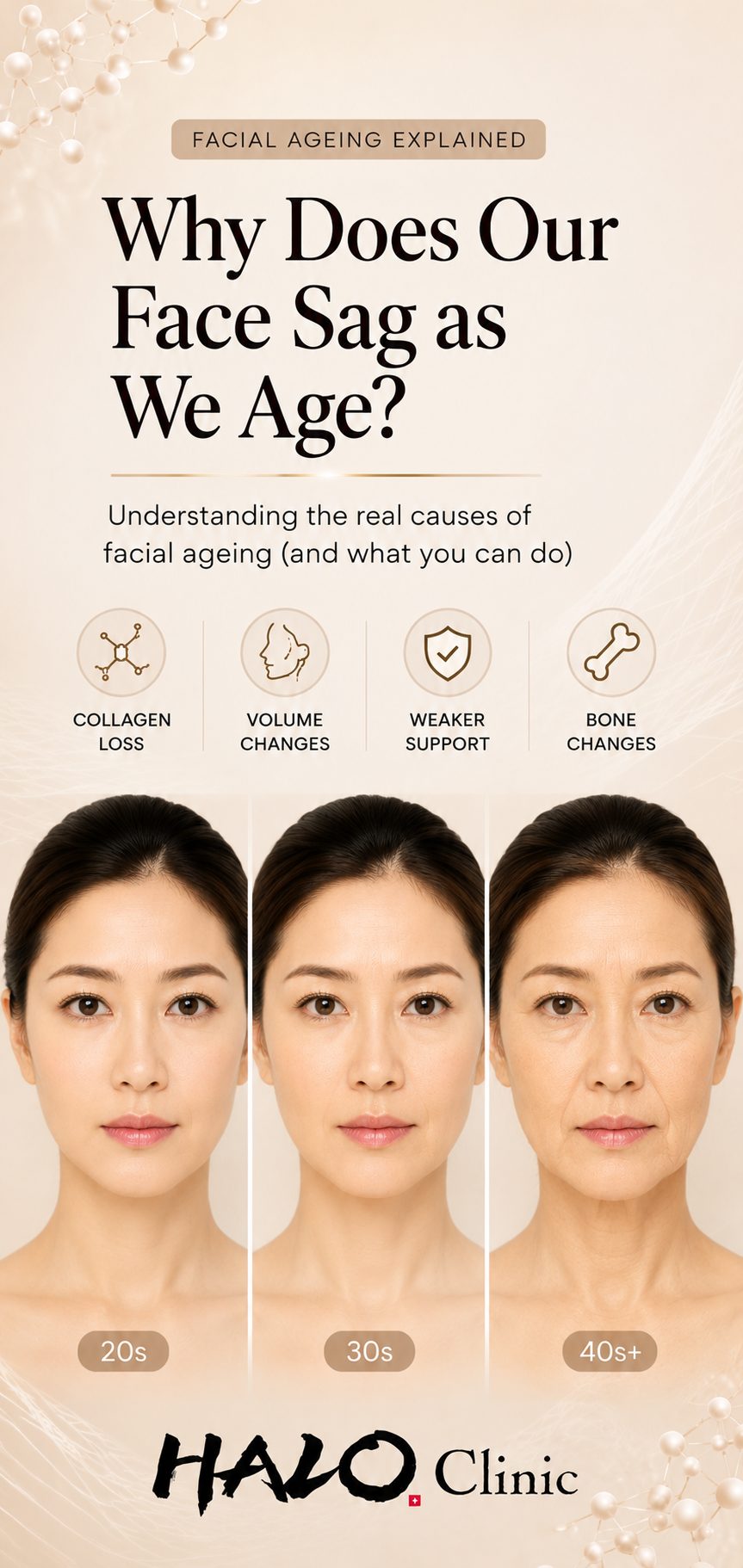
Why Does Our Face Sag as We Age?
Many people notice subtle changes in the mirror long before they consider themselves "old." The jawline becomes less defined, the cheeks appear flatter, smile lines deepen, and the face may look more tired even after a good night's sleep. While it is common to think that loose skin is the main culprit, facial ageing is actually a complex process involving changes in the skin, fat, ligaments, muscles, and even the facial bones.
Understanding what causes these changes is the first step towards choosing the right treatment. Different layers of the face age differently, and no single treatment can address every aspect of ageing.
1. Collagen Loss Causes the Skin to Become Thinner
Collagen is the main structural protein responsible for keeping our skin firm, smooth, and resilient. From our mid-twenties onwards, collagen production gradually declines. As collagen decreases, the skin becomes thinner, less elastic, and slower to repair itself.
This contributes to:
Fine lines and wrinkles
Crepey skin
Reduced skin firmness
Slower healing after injury
Treatments that stimulate collagen production can help improve skin quality over time, but collagen alone is only one piece of the puzzle.
2. Facial Fat Changes with Age
The youthful face contains multiple fat compartments that provide natural volume and soft contours. As we age, these fat pads change in two important ways. Some shrink, particularly in the cheeks and temples, creating a hollow appearance. Others descend due to gravity and weakening support structures, contributing to jowls, deep nasolabial folds, and marionette lines.
These changes can make the face appear older even if the skin itself remains in relatively good condition.
3. The Supporting Ligaments Become Weaker
The face is supported by a network of retaining ligaments that anchor the soft tissues to the underlying bone. Over time, these ligaments lose strength and elasticity, allowing the overlying tissues to descend.
This contributes to:
Sagging cheeks
Loss of jawline definition
Jowls
Heavier lower face
Modern non-surgical treatments often aim to restore support rather than simply adding volume.
4. Facial Bones Also Change
One of the lesser-known aspects of facial ageing is the gradual remodelling of the facial skeleton. The eye sockets enlarge, the jawbone becomes less defined, and areas of the mid-face lose structural support.
As the foundation changes, the overlying soft tissues have less support, further contributing to facial sagging and volume loss.
This is one reason why restoring structure in carefully selected areas can create a more natural rejuvenation than simply filling visible lines.
5. Muscle Activity Creates Wrinkles
Every time we smile, frown, or raise our eyebrows, the facial muscles contract. Over many years, these repeated movements create expression lines that eventually become visible even when the face is at rest.
Common examples include:
Forehead lines
Frown lines
Crow's feet
These are known as dynamic wrinkles, and early treatment may help delay the formation of permanent static wrinkles.
Why Simply Tightening the Skin Isn't Always Enough
Many patients assume facial ageing is purely a skin problem. In reality, ageing affects every layer of the face.
A treatment that only tightens the skin may not restore lost facial support. Likewise, replacing volume alone may not improve skin laxity or skin quality.
The most natural-looking results are often achieved by addressing the underlying causes of ageing rather than focusing on a single concern.
A Personalised Approach to Facial Rejuvenation
There is no universal solution for facial ageing because every face ages differently. Factors such as genetics, sun exposure, lifestyle, and facial anatomy all influence how ageing develops.
At Halo Clinic, Dr Delong Zeng takes a comprehensive approach to facial rejuvenation. Drawing on extensive experience in facial anatomy, plastic surgery, and dermatology, he assesses how each layer of the face has changed before recommending treatment. Depending on your concerns, your personalised plan may include collagen-stimulating injectables, skin boosters, HIFU, energy-based devices, wrinkle-relaxing injections, or a combination of treatments designed to restore natural facial balance while preserving your unique features.
FAQ
At what age does facial sagging begin?
Collagen production starts to decline from our mid-twenties, although visible sagging usually becomes more noticeable in the thirties and forties. Genetics, sun exposure, smoking, and lifestyle factors all influence how quickly these changes develop.
Can skincare alone prevent facial sagging?
A good skincare routine helps maintain healthy skin, but topical products cannot replace lost facial volume, strengthen weakened ligaments, or reverse structural changes in the deeper layers of the face.
What is the best treatment for facial sagging?
There is no single "best" treatment. The most effective approach depends on the cause of the sagging. Some patients benefit from collagen stimulation, while others may require lifting, skin tightening, wrinkle reduction, or a combination of treatments.
Can non-surgical treatments replace a surgical face-lift?
Non-surgical treatments can achieve meaningful improvements, particularly for mild to moderate ageing, but they cannot replicate the degree of lifting achieved with surgery in patients with more advanced skin laxity.
Key Takeaways
Facial ageing affects the skin, fat, ligaments, muscles, and underlying bone.
Collagen loss is only one of several factors that contribute to facial sagging.
The most natural-looking results come from understanding which layers of the face are ageing and treating them appropriately.
A personalised treatment plan is often more effective than relying on a single procedure.
Share