


Why Treating the Cheeks Alone Does Not Lift the Face
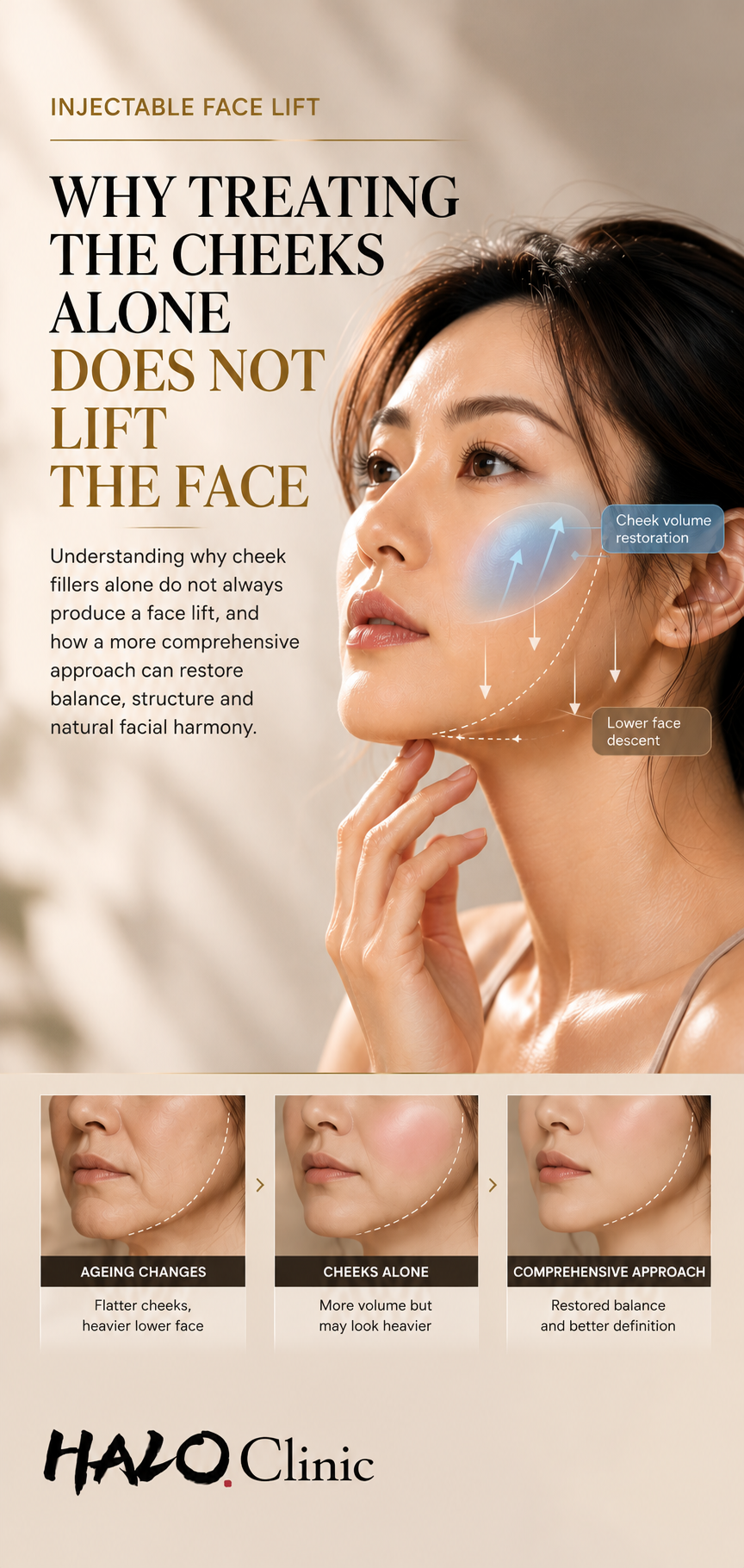
Why Treating the Cheeks Alone Does Not Lift the Face
One of the most common approaches to facial rejuvenation is to restore volume to the cheeks. The reasoning appears straightforward: as we age, the cheeks become flatter, the midface loses its youthful fullness, and the lower face begins to sag. By restoring volume to the cheeks, we hope to recreate the support that has been lost and improve the appearance of the entire face.
While this approach can be effective in appropriately selected patients, it is important to understand that adding volume to the cheeks is not necessarily the same as lifting the face. In fact, one of the problems I frequently encounter in facial rejuvenation is the assumption that more cheek volume will automatically produce a stronger lifting effect.
The face is a complex three-dimensional structure. Its appearance depends not only on the amount of volume present, but also on the distribution of that volume, the integrity of the underlying support structures, and the relationship between different anatomical regions. As these relationships change with age, simply restoring fullness to one area may not adequately address the underlying cause of facial sagging.
To understand why cheek treatments sometimes fail to produce the desired lifting effect, we first need to examine how the face actually ages.
Facial Ageing Is Not Simply a Loss of Cheek Volume
Facial ageing involves changes across multiple anatomical layers, including the skin, superficial and deep fat compartments, retaining ligaments, muscles and facial skeleton. These structures do not age uniformly, and the changes occurring in one region frequently influence the appearance of neighbouring regions.
The deep fat compartments of the midface may undergo volume loss, while changes in the superficial fat compartments and supporting structures can alter the distribution and appearance of facial fullness. At the same time, skeletal remodelling changes the underlying foundation upon which the soft tissues rest. Collagen loss and changes in skin elasticity further contribute to the gradual deterioration of facial contours.
As a result, the cheeks may appear flatter while the lower face becomes relatively heavier. However, the flattening of the cheeks is only one component of a much broader process. The temples may also lose volume, the lateral facial framework can become less prominent, and the relationship between the cheek, jawline and chin gradually changes.
If we concentrate exclusively on restoring cheek volume without considering these other changes, we may improve the fullness of the midface without meaningfully improving the overall facial architecture.
This distinction is fundamental to understanding why a fuller face does not necessarily look younger or more lifted.
Volume and Structural Support Are Not the Same Thing
In aesthetic medicine, volume restoration and structural support are closely related concepts, but they should not be treated as interchangeable.
Volume restoration refers to replacing or augmenting tissue fullness within a particular anatomical region. Structural support, on the other hand, involves understanding how the underlying facial framework contributes to the shape, projection and relationships between different parts of the face.
An injectable product placed in an appropriate deep anatomical plane may improve local structural support and projection. However, this does not mean that the same product, placed in a different location or tissue plane, will produce an equivalent effect. The result depends on the patient's anatomy, the mechanical properties of the product, the amount injected and the surrounding tissues.
This is why injection depth and placement are so important. A product intended to provide deep structural support should not be expected to behave identically when placed more superficially. Similarly, increasing the amount of product does not necessarily compensate for an incorrect anatomical strategy.
A successful injectable face lift therefore requires more than identifying where volume has been lost. It requires determining which areas would benefit from structural restoration, which areas require contour refinement, and which changes cannot be adequately addressed through injectables alone.
Why Central Cheek Augmentation Can Sometimes Make the Face Look Heavier
The central cheeks are among the most frequently treated regions in aesthetic medicine. They are also an area where excessive or poorly planned volume restoration can significantly alter facial proportions.
When the midface loses fullness, it is tempting to replace the missing volume directly. However, if the lateral facial framework remains relatively deficient, increasing central cheek projection can sometimes make the face appear rounder or heavier rather than more lifted.
This occurs because facial beauty is not determined by the prominence of individual features. It depends on the relationship between those features. A prominent cheek may look attractive when supported by appropriate temple contours, lateral cheek structure and balanced lower facial proportions. The same degree of projection may appear disproportionate when the surrounding facial framework is relatively flat.
Excessive central cheek augmentation can also reduce the distinction between neighbouring anatomical regions. Rather than restoring the smooth transitions associated with a youthful face, it may create an isolated area of fullness that draws attention to itself.
The problem is therefore not necessarily the amount of volume alone, but where that volume is placed and how it relates to the rest of the face.
The Outer Framework Plays an Important Role in Facial Design
One of the central principles of my approach to injectable facial rejuvenation is to assess the outer framework of the face before concentrating on the central regions.
The temples, zygomatic arch, lateral cheeks, preauricular region, jawline and chin collectively contribute to the overall shape and proportions of the face. These areas establish much of the visual framework within which the central facial features are perceived.
As the face ages, loss of volume and changes in structural support within the outer regions can make the central face appear relatively more prominent. The lower face may also become visually heavier as the balance between the upper, lateral and lower facial regions changes.
By first evaluating the outer framework, we can identify whether restoring support in selected lateral regions would improve facial proportions before adding volume centrally.
For example, temple hollowing can interrupt the transition between the forehead and cheeks, making the lateral face appear narrower or less continuous. Similarly, reduced projection over the lateral zygomatic region may alter the perceived relationship between the upper cheek and lower face.
Restoring appropriate contours in these regions can improve the visual balance of the face. In selected patients, it may also reduce the amount of central cheek augmentation required to achieve the desired result.
However, it is important to distinguish improvement in facial proportions from physically lifting descended tissues. Lateral injectable placement does not reliably produce a mechanical lifting effect throughout the lower face, and the degree of improvement depends on the individual's anatomy.
A Natural Face Lift Requires Smooth Facial Contours
When assessing the aesthetic outcome of injectable treatments, I place considerable importance on the continuity of facial contours.
A youthful face is not simply a collection of prominent cheeks, a defined jawline and a projected chin. These features need to relate harmoniously to one another. The transitions between the forehead, temples, cheeks and lower face should appear smooth and anatomically appropriate.
These transitions also influence how light reflects across the face. Smooth contours create relatively continuous highlights, while abrupt changes in projection can produce shadows that make the face appear more hollow, irregular or tired.
As facial ageing progresses, the loss of structural support and changes in soft tissue distribution interrupt these transitions. Areas of hollowing develop beside regions of relative fullness, creating increasingly noticeable differences between adjacent anatomical structures.
The objective of injectable rejuvenation should therefore be to restore continuity rather than simply increase projection.
This is particularly important when treating the cheeks. An isolated increase in cheek prominence may be immediately noticeable, but it does not necessarily improve the overall face. In contrast, carefully restoring the relationship between the temples, lateral cheeks and central midface may create a more balanced appearance without requiring excessive volume.
The most successful result is often not the one with the most prominent cheeks, but the one where no individual region appears to have been treated in isolation.
The Direction of Facial Support Matters More Than Simply Adding Volume
Facial ageing is frequently described as a downward movement of tissues. Although this description is useful, it does not fully explain the anatomical changes involved.
The face is supported by a complex arrangement of retaining ligaments, fascial structures, fat compartments and skeletal attachments. These structures influence how tissues are positioned and how they respond to changes in volume and mechanical support.
Injectable treatments can modify local tissue contours and, in selected circumstances, provide support to specific anatomical regions. However, they do not reproduce the tissue repositioning achieved through surgical lifting procedures.
This distinction is important because adding product to a particular location does not automatically generate a predictable lifting force in another part of the face. The relationship between injection placement and visible improvement is considerably more complex.
For this reason, I prefer to approach an injectable face lift as a process of structural restoration and facial design rather than simply attempting to push tissues upwards through additional volume.
The objective is to improve facial proportions, restore appropriate support where possible and reduce the visual imbalance associated with ageing. In some patients, these changes can create a meaningful lifting appearance even though the underlying tissues have not been surgically repositioned.
Why More Cheek Filler Does Not Necessarily Produce More Lift
Another common misconception is that increasing the amount of cheek filler will produce progressively greater lifting effects.
In reality, there is a limit to how much improvement can be achieved through volume restoration. Once the desired structural support and contour have been established, additional product may provide diminishing aesthetic benefit.
Beyond this point, further augmentation can increase facial width or projection without meaningfully improving the appearance of tissue descent. The face may become fuller while the jawline remains poorly defined and the lower facial tissues continue to appear heavy.
This is particularly relevant in patients who have undergone repeated injectable treatments over several years. If each treatment session focuses on adding more volume without reassessing the entire facial structure, the cumulative effect can gradually alter natural facial proportions.
An important part of clinical judgement is therefore recognising when additional treatment is no longer beneficial. Rather than automatically increasing the number of syringes, the doctor should reassess the underlying cause of the patient's concern and determine whether a different treatment strategy is required.
Sometimes the correct decision is to treat another anatomical region. Sometimes it is to consider skin tightening or another modality. In other cases, the most appropriate decision is not to inject further.
When Cheek Augmentation Is Actually Appropriate
None of this means that the cheeks should not be treated. Appropriate cheek augmentation remains an important component of facial rejuvenation, particularly in patients with genuine midface volume deficiency or insufficient skeletal projection.
The key is to distinguish between patients who require local volume restoration and those whose primary concern arises from broader changes in facial support, tissue distribution or skin laxity.
In a patient with significant deep midface volume loss, carefully placed injectable treatment may restore projection and improve the transition between the lower eyelid and cheek. In another patient with relatively full central cheeks but hollow temples and reduced lateral definition, additional central cheek volume may be unnecessary.
The treatment plan should therefore follow the anatomy rather than a standardised approach.
This is also where the selection of injectable material becomes important. Different products have different rheological properties, tissue interactions and intended treatment depths. Hyaluronic acid fillers and collagen biostimulators may each have a role depending on whether the objective is immediate structural support, volume restoration or gradual improvement in tissue quality.
However, the choice of product should come after the facial assessment. Selecting an injectable before identifying the anatomical problem reverses the logical sequence of treatment planning.
When Skin Tightening May Be More Appropriate Than Additional Injectables
Not every patient who complains of sagging cheeks or a heavier lower face requires more volume.
In patients where skin laxity and soft tissue descent are the dominant concerns, further injectable augmentation may provide limited benefit. This is particularly relevant when the face already has adequate volume but lacks firmness and definition.
Treatments such as HIFU can be considered when tissue tightening and collagen remodelling are appropriate objectives. These treatments work through mechanisms different from those of injectable structural restoration and may address aspects of facial ageing that cannot be corrected simply by adding volume.
Nevertheless, energy-based treatments also have limitations. Their effects depend on the patient's anatomy, the degree of laxity and the treatment parameters used. They cannot replace substantial skeletal or soft tissue volume deficiencies, and they should not be presented as equivalent to surgical lifting.
In patients with multiple contributing factors, a combination of structural restoration and tissue tightening may be more appropriate than relying exclusively on either approach.
The important principle remains the same: identify the anatomical cause before selecting the treatment.
Facial Design Should Always Come Before Injection Points
One of the reasons injectable treatments sometimes produce disappointing results is that treatment planning becomes focused on individual injection points rather than the overall facial design.
It is possible to perform technically accurate injections into recognised anatomical locations and still produce an aesthetically unsatisfactory result. Correct placement alone does not guarantee that the treatment is appropriate for the patient's facial proportions.
Before deciding where to inject, I assess the overall shape of the face, the distribution of volume, the relationship between the upper and lower facial regions and the continuity of facial contours. I also consider how the face appears from different angles and during natural expression.
This assessment helps determine which areas should be prioritised, which should be treated conservatively and which may not require treatment at all.
The objective is not to fill every hollow or enhance every feature. It is to understand how each proposed injection will influence the appearance of the entire face.
A good injectable treatment should improve facial harmony without making any particular feature appear unnecessarily prominent.
Achieving this requires not only anatomical knowledge and technical precision, but also the ability to recognise when restraint will produce a better aesthetic outcome.
The Halo Clinic Approach
At Halo Clinic, an injectable face lift is approached as a comprehensive facial design procedure rather than a collection of individual filler treatments.
Drawing upon over 10 years of clinical experience together with extensive training in Plastic Surgery, General Surgery and Dermatology, I begin by assessing how the facial structure has changed over time. This includes evaluating the temples, lateral cheeks, zygomatic region, central midface, jawline and chin as interconnected parts of a single anatomical framework.
Where appropriate, I prioritise restoring the outer facial framework before concentrating on the central face. This allows the overall proportions and contour relationships to be reassessed before deciding whether additional cheek augmentation is necessary.
My objective is not to create prominent cheeks or use a predetermined number of syringes. It is to restore appropriate support, improve the continuity of facial contours and achieve a balanced result that respects the patient's natural facial structure.
Injectable products are tools used to achieve these objectives. Their effectiveness depends on understanding where they are needed, how they should be placed and when further treatment is no longer beneficial.
Ultimately, an injectable face lift should not be judged by how much volume has been added to the cheeks. It should be judged by whether the face as a whole looks more balanced, better supported and naturally harmonious.
Frequently Asked Questions
Can cheek fillers actually lift the face?
Cheek fillers can improve local structural support, projection and facial contours in appropriately selected patients. These changes may create the appearance of lifting, particularly when midface volume loss contributes to facial ageing. However, fillers do not reproduce the tissue repositioning achieved through surgical lifting, and their effects on other facial regions should not be assumed to be predictable or substantial.
Why do some people look heavier after cheek fillers?
This can occur when excessive volume is added to the central cheeks or when cheek augmentation is performed without considering the surrounding facial structure. Increasing projection in one region may disrupt facial proportions, particularly when the lateral face remains relatively deficient. The result can be a fuller face without a corresponding improvement in overall facial balance.
Why do you prefer treating the outer face before the central cheeks?
The outer facial framework contributes significantly to the overall shape and proportions of the face. Assessing the temples, lateral cheeks and zygomatic region first helps determine whether structural restoration in these areas would improve facial balance. Once this framework has been addressed, the central face can be reassessed to determine whether additional volume is necessary.
Can treating the temples improve the appearance of my cheeks?
In selected patients, restoring temple volume can improve the transition between the forehead, temples and lateral cheeks. This may create a more continuous facial contour and improve the overall proportions of the upper and midface. However, temple treatment should not be expected to physically lift the cheeks in every patient.
Are collagen biostimulators better than hyaluronic acid fillers for an injectable face lift?
Neither category is universally superior. Hyaluronic acid fillers and collagen biostimulators have different properties and may be selected for different anatomical and treatment objectives. Some products are more appropriate for immediate contour restoration, while others are used to stimulate gradual collagen formation or improve tissue quality. The most appropriate choice depends on the patient's anatomy, the intended injection plane and the desired result.
How many syringes are needed for an injectable face lift?
There is no standard number of syringes suitable for every patient. The amount required depends on facial anatomy, the degree of structural deficiency, the areas being treated and the type of injectable used. Treatment should be guided by the improvement achieved rather than by a predetermined quantity of product.
Can I achieve a natural face lift without making my cheeks bigger
Yes, in selected patients. Improving the overall facial proportions may involve restoring support in the outer framework, refining contour transitions or addressing skin laxity rather than increasing central cheek volume. The treatment strategy should be based on the anatomical changes responsible for the patient's concerns.
How do I know whether I need cheek fillers or skin tightening?
This depends on whether the main problem is volume deficiency, reduced structural support, skin laxity or a combination of these factors. A detailed facial assessment is necessary to determine which changes are contributing most significantly to the appearance of ageing. Some patients may benefit from injectables, others from skin tightening, and some from a combination of treatments.
Key Takeaways
Adding volume to the cheeks is not necessarily the same as lifting the face. Successful facial rejuvenation requires understanding the structural changes responsible for facial ageing.
Facial ageing involves multiple anatomical layers, including skin, fat compartments, retaining ligaments and bone. Cheek volume loss is only one component of this process.
Structural support and volume restoration are related but distinct treatment objectives. The anatomical placement, depth and amount of injectable product all influence the result.
Excessive central cheek augmentation can sometimes make the face appear heavier or rounder, particularly when the surrounding facial framework has not been adequately considered.
The temples, lateral cheeks and zygomatic region contribute to the outer facial framework and play an important role in determining overall facial proportions.
Smooth transitions between neighbouring anatomical regions are often more important to facial harmony than the prominence of any individual feature.
More injectable product does not necessarily create more lift. Once appropriate structural restoration has been achieved, additional volume may compromise facial definition.
Cheek augmentation remains appropriate for selected patients with genuine midface volume deficiency, but it should not be applied as a universal solution for facial sagging.
Skin tightening and injectable structural restoration address different components of facial ageing. The most appropriate treatment depends on the underlying anatomical problem.
Ultimately, an effective injectable face lift depends on comprehensive facial assessment, thoughtful facial design, precise injection technique and the clinical judgement to recognise when further treatment is unnecessary.
Share