


Why the Lower Face Becomes Heavier With Age
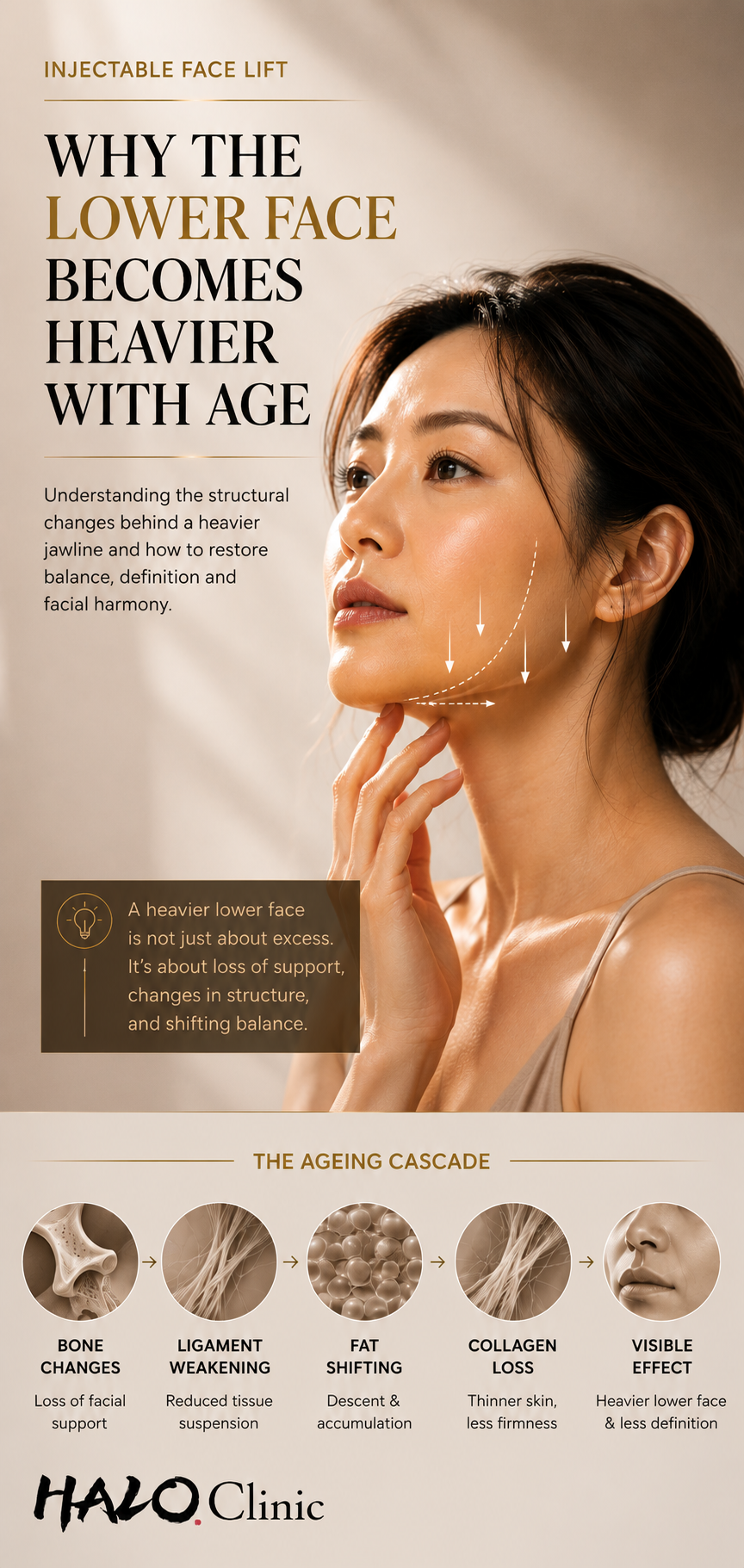
One of the most noticeable changes that occurs with facial ageing is a gradual shift in where the face appears to carry its weight. A younger face often appears relatively supported through the upper and outer portions of the face, with a smooth transition from the temples through the cheeks and into a well-defined lower facial contour. As we age, this relationship gradually changes. The upper face may appear flatter or more hollow while the lower face begins to look broader, heavier and less defined.
Patients often describe this as developing a heavier jawline, a squarer face or increasing fullness around the mouth and lower cheeks. It is understandable to assume that the problem is simply excess tissue accumulating in the lower face. In reality, facial ageing is considerably more complex. What appears to be a lower-face problem is frequently the visible consequence of structural changes occurring throughout the face.
Understanding this distinction is important because simply treating where the heaviness is visible does not necessarily address why it developed. To improve the lower face effectively, we first need to understand how the entire facial framework has changed.
A Younger Face Has a Different Distribution of Support
When assessing facial ageing, I find it useful to think about the distribution of support rather than simply the amount of volume present. A youthful face tends to have relatively strong support through the temples, lateral cheeks and upper facial framework. This creates a smooth transition through the outer face and helps maintain definition as the face narrows towards the jawline and chin.
With ageing, this distribution gradually changes. The temples may become hollow, the lateral cheeks can flatten, the underlying skeletal framework changes and the soft tissues become less firmly supported. At the same time, the distinction between the cheek and lower face becomes less defined. The visual centre of gravity of the face therefore begins to move downwards.
This is one of the reasons a face can appear heavier even without a substantial increase in facial fat. The problem is not necessarily that there is suddenly too much tissue in the lower face. Rather, the relationship between the upper, lateral and lower portions of the face has changed.
Facial Ageing Occurs Across Multiple Anatomical Layers
The face should never be thought of as skin sitting over a single layer of fat. It is a complex anatomical structure consisting of skin, superficial and deep fat compartments, retaining ligaments, muscles and bone. Each of these structures changes with age, and the visible appearance of facial ageing is the combined result of these changes.
Collagen and elastin within the skin gradually decline, reducing its ability to maintain firmness and recoil. Facial fat compartments can change in both volume and position. Retaining structures become less effective at maintaining the relationships between different tissues, while the underlying facial skeleton itself undergoes remodelling over time. These processes do not occur uniformly across the face.
The result is not simply that everything moves downwards by the same amount. Some areas lose support, some become hollow, some tissues become more visible, and transitions that were once smooth become increasingly irregular. The lower face is often where many of these changes become most noticeable, but it is rarely where the ageing process began.
Loss of Lateral Support Can Make the Lower Face Appear Heavier
The lateral face plays an important role in maintaining facial shape. The temples, zygomatic region, lateral cheeks and preauricular area form part of the outer framework that gives the face its overall structure.
As these regions lose support, the face can gradually appear less elevated laterally and more visually concentrated towards the centre and lower face. The smooth transition between the cheek and jawline becomes interrupted, while the lower cheek may become increasingly prominent relative to the flatter upper and outer face.
This is an important concept because patients frequently request treatment directly along the lower face when the more significant structural deficiency is actually located higher and further laterally. If we only focus on the area where heaviness is visible, we may be treating the consequence rather than the cause.
For this reason, my facial assessment frequently begins away from the patient's primary concern. Before deciding what should be done to the jawline or lower cheek, I first assess whether the outer facial framework is providing adequate support.
The Jawline Changes Because Its Surroundings Change
A defined jawline is not created by the mandible alone. Its appearance depends on the relationship between the jawbone, chin, overlying soft tissues, lateral face and neck. When these structures are in balance, the lower border of the face appears relatively continuous and well defined.
With age, that continuity can gradually become disrupted. Changes in the surrounding soft tissues create areas of fullness beside areas of relative deficiency, and the transition from the cheek into the jawline becomes less smooth. The chin may also appear less structurally dominant relative to the surrounding tissues, further altering the proportions of the lower face.
This is why simply trying to make the jawline sharper is not always the correct solution. The first question should be why the jawline has become less defined. Depending on the individual, the answer may involve loss of support elsewhere, changes in tissue distribution, skin laxity, skeletal proportions or a combination of several factors.
Different causes require different treatments.
Why Adding Volume to the Central Face Can Sometimes Make the Problem Worse
When the cheeks flatten with age, it may seem logical to restore volume directly to the central cheeks. In selected patients this can certainly be appropriate, but treating the central face without first considering the outer framework can sometimes make an already heavy face appear even heavier.
This occurs because additional central volume does not necessarily restore the direction of support that has been lost. If the lateral face remains relatively unsupported, increasing central projection may simply add more visual weight to the middle of the face. The patient may have more prominent cheeks afterwards, but the overall facial architecture has not necessarily become more youthful.
This is why I generally prefer to think in terms of support before volume. The objective is not simply to replace everything that appears to have disappeared. It is to determine where restoring structure will have the greatest effect on the face as a whole.
Why I Often Restore the Outer Frame Before the Lower Face
In many patients undergoing an injectable face lift, I begin by assessing and, where appropriate, restoring the outer framework of the face before treating the lower face directly.
The temples, lateral cheeks, zygomatic region and other areas of the outer face help establish the boundaries and proportions of the face. When appropriate support is restored here, the relationship between the upper and lower face can improve. The face may appear more balanced, the lateral contour becomes smoother and the apparent heaviness of the lower face may become less dominant.
Only after this framework has been addressed do I reassess the jawline, chin and central face. This reassessment is important because the amount of treatment initially thought necessary may change once the surrounding structure has been improved.
This does not mean that every patient requires treatment to the same areas, nor does it mean that restoring the outer face will physically lift every form of lower facial laxity. It means that facial rejuvenation should follow the anatomy and structural changes of the individual rather than a predetermined set of injection points.
Skin Tightening and Structural Support Are Not the Same Thing
Another important distinction is the difference between skin laxity and loss of facial support. They often occur together, but they are not the same problem.
Treatments such as HIFU and other energy-based procedures are designed to influence tissue tightening and collagen remodelling. These treatments can be useful when laxity is an important component of the patient's ageing pattern. However, tightening the skin cannot replace structural support that has been lost within deeper layers of the face.
Conversely, injectable treatments should not be expected to correct every degree of tissue laxity simply by adding more product. Attempting to compensate for significant laxity with excessive injectable volume can make the face larger without adequately addressing the underlying problem.
For some patients, the most logical approach is therefore a combination of treatments. Structural support can be restored where appropriate, while skin and deeper tissues are treated separately when tightening is required. The correct balance depends on the anatomy of the individual patient.
The Goal Is Not Simply a Sharper Jawline
It is easy to judge lower-face rejuvenation by looking only at the jawline. However, a sharply defined jawline does not automatically create a younger or more attractive face.
The jawline needs to belong to the rest of the face. Its width, angle and relationship with the cheeks and chin should remain appropriate for the patient's natural anatomy. Excessive attempts to sharpen or enlarge the lower facial framework can create a result that looks technically defined but aesthetically disconnected from the rest of the face.
My objective is therefore not to create the sharpest possible jawline. It is to restore a smoother transition from the lateral cheeks through the lower face and towards the chin while maintaining appropriate facial proportions. When this is done well, the lower face usually appears lighter and better defined without looking artificially sculpted.
Facial Rejuvenation Is About Redistributing Visual Balance
One of the most useful ways to understand facial rejuvenation is to consider how visual weight is distributed across the face. Ageing often causes the upper and outer face to lose prominence while the central and lower face become increasingly dominant. This change in proportion contributes significantly to the perception of an older or heavier face.
Effective rejuvenation attempts to restore balance rather than simply add volume. In some patients this means rebuilding support. In others, tissue tightening may play a greater role. Some patients require treatment of the chin or jawline, while others benefit more from addressing the lateral face first.
The important point is that the treatment should follow the structural diagnosis. Once we understand why the face has become heavier, the treatment strategy becomes much more logical.
The Halo Clinic Approach
At Halo Clinic, I do not assess lower-face ageing by looking at the jawline alone. The entire face is examined to understand how its proportions, support and contours have changed over time.
Drawing upon over 10 years of clinical experience together with extensive training in Plastic Surgery, General Surgery and Dermatology, I assess the relationship between the temples, cheeks, lateral face, jawline and chin before deciding where treatment should begin. In many patients, this means considering the outer facial framework before directly treating the areas where ageing appears most obvious.
This approach also explains why there is no standard number of syringes, fixed injection pattern or single procedure that is appropriate for every ageing face. Two patients may both complain that their lower face has become heavier while having completely different anatomical reasons for that change.
The objective is therefore not simply to treat what has become visible. It is to understand why it became visible in the first place and design treatment around that underlying structural change.
Frequently Asked Questions
Why is my lower face becoming wider as I get older?
A wider or heavier lower face can develop from several age-related changes occurring simultaneously. Loss of support through the upper and lateral face, changes in facial fat, reduced tissue firmness and changes in the underlying skeletal framework can all alter the proportions of the face. The lower face may therefore appear wider even when there has not been a significant increase in facial fat.
Is a heavy lower face always caused by sagging skin?
No. Skin laxity can contribute, but the appearance of lower-face heaviness may also result from changes in deeper tissues, loss of lateral support, facial fat distribution and skeletal proportions. This is why determining which anatomical layers are responsible is important before choosing a treatment.
Can injectables lift the lower face?
Injectable treatments can improve structural support, facial proportions and contour in appropriately selected patients. However, they should not be viewed as a way of simply filling or pulling the lower face upwards. The effect depends on the patient's anatomy, degree of tissue laxity and where structural support has been lost.
Why would you treat my temples or lateral cheeks if I am concerned about my jawline?
The area where ageing is most visible is not always where the underlying structural change originated. Loss of support through the temples and lateral cheeks can alter the proportions of the entire face and make the lower face appear relatively heavier. Restoring the outer framework where appropriate can therefore change how the lower face is perceived before it is treated directly.
Is HIFU better than injectables for a heavy lower face?
They address different aspects of facial ageing. HIFU is primarily used when tissue tightening and collagen remodelling are required, whereas injectable treatments can be used to restore structural support and facial proportions. Some patients may benefit predominantly from one approach, while others may require a combination depending on their anatomy.
Will adding more product give me a stronger lifting effect?
Not necessarily. Once appropriate structural support has been achieved, adding further volume may simply make the face larger or heavier. The amount of product should therefore be determined by the anatomical objective rather than by the assumption that more product will produce more lift.
Can the lower face be treated without changing how I naturally look?
That should be the objective. Good facial rejuvenation should respect the patient's existing skeletal structure, proportions and identity. Treatment should improve the relationship between facial regions rather than create an entirely new facial shape.
Key Takeaways
A heavier lower face is not simply the result of excess tissue accumulating around the jawline. It is often the visible consequence of ageing occurring throughout the face.
Loss of support in the temples, lateral cheeks and outer facial framework can change facial proportions and make the central and lower face appear relatively heavier.
Facial ageing occurs across the skin, fat compartments, retaining structures and underlying bone, which is why no single anatomical layer explains every patient's changes.
The area where ageing is most visible is not necessarily the area that should be treated first.
Adding volume directly to the central face without considering lateral support can sometimes increase facial heaviness rather than improve it.
Skin tightening and structural restoration address different components of facial ageing and may need to be considered separately.
A successful injectable face lift should restore overall facial balance rather than simply create a sharper jawline.
The most important step is identifying why the lower face has changed before deciding how it should be treated.
Share