


Why Some Injectable Treatments Look Unnatural
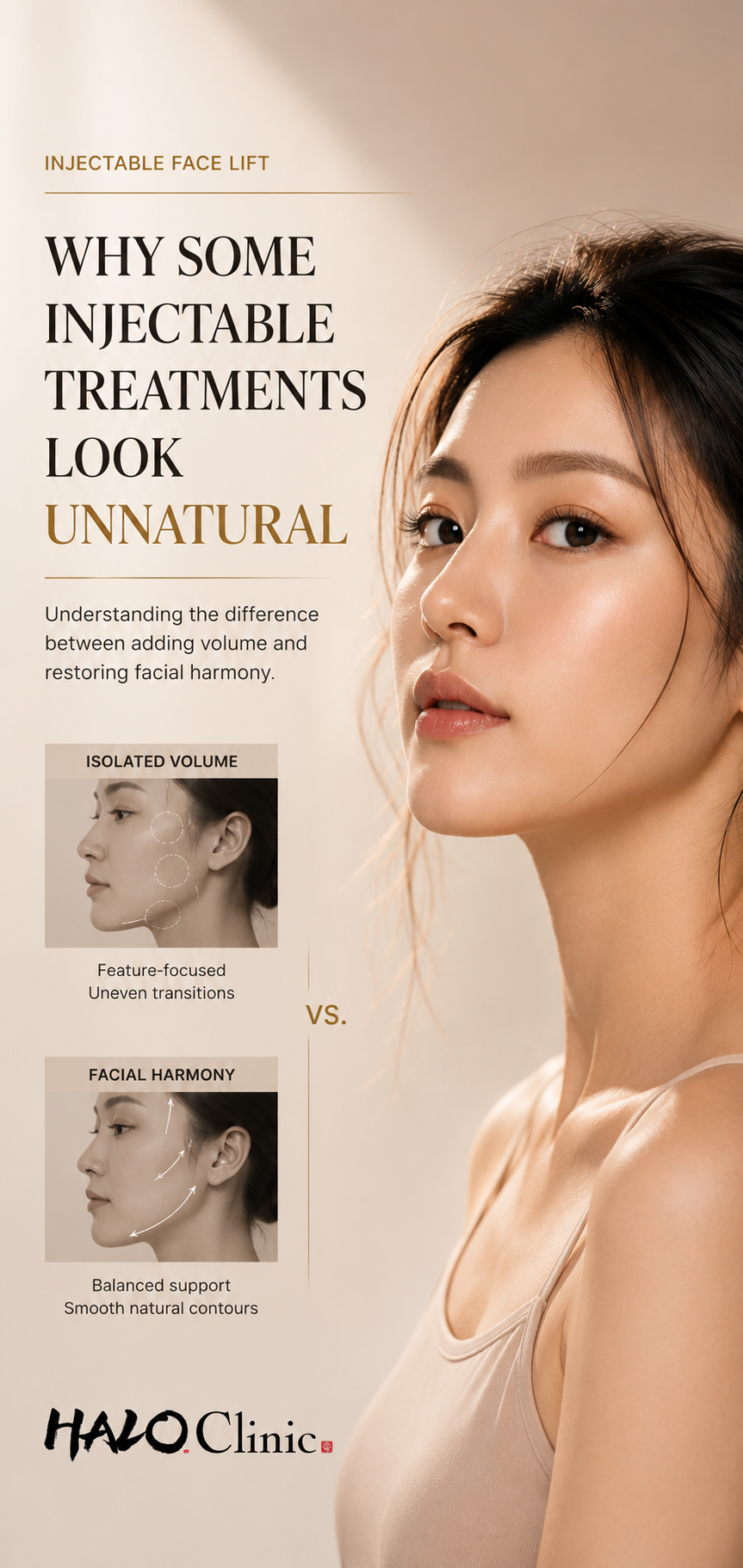
One of the most common concerns I hear during consultation is not whether injectable treatments work. Rather, patients worry about whether they will still look like themselves afterwards.
This concern is entirely understandable. Most people have seen examples of faces that appear overfilled, disproportionate or simply different from the person's natural appearance. As a result, many assume these changes are an unavoidable consequence of injectable treatments.
In reality, this is rarely the case. Injectable products themselves do not determine whether a result looks natural or unnatural. The way the face is assessed, the treatment is planned, and the product is placed all have a far greater influence on the final outcome. Understanding this distinction is fundamental to achieving elegant facial rejuvenation.
The Face Ages as a Whole, Not as Individual Parts
One of the most common mistakes in facial rejuvenation is treating the face as a collection of independent problems.
A patient may notice flattening of the cheeks, another may be concerned about the jawline, while someone else focuses on folds around the mouth. Although these concerns are genuine, they are often manifestations of a broader structural ageing process rather than completely separate problems.
The face functions as one continuous three-dimensional structure. Every anatomical region influences the appearance of its neighbouring regions. Loss of support within the temples can change the perception of the cheeks, while changes around the lateral face can influence the appearance of the jawline and lower face. Weakening of the facial framework can also alter how the central face is perceived.
For this reason, it is rarely appropriate to treat a single feature without considering the rest of the face. Every injection should be considered within the context of the entire facial architecture.
Projection Does Not Equal Beauty
There is a common misconception that increasing projection automatically creates a more youthful or attractive face. In reality, a youthful face is not defined by prominent cheeks, an exaggerated jawline or a sharply projected chin. It is characterised by balanced proportions, appropriate structural support and smooth transitions between different facial regions.
When one feature is enhanced without considering the surrounding anatomy, it can become visually dominant. Although the individual feature may appear more prominent, the face as a whole may actually become less harmonious.
Successful facial rejuvenation is therefore not about maximising projection. It is about understanding where projection is appropriate, where support has been lost and how each change will influence the overall proportions of the face.
Smooth Contours Are More Important Than Individual Features
When we recognise someone as looking youthful, we rarely focus on one specific anatomical feature. Instead, our eyes naturally appreciate the overall balance of the face.
Youthful faces tend to have smooth transitions between adjacent anatomical regions. The forehead flows naturally into the temples, the temples blend into the cheeks, and the cheeks transition smoothly towards the jawline. These uninterrupted contours allow light to reflect evenly across the face, producing an appearance that feels healthy, elegant and balanced.
As structural support diminishes over time, these transitions become interrupted. Hollows can develop beside areas of fullness, contour changes become more abrupt and shadows become increasingly apparent. The face gradually loses some of its natural flow, even when there is no single feature that appears obviously abnormal.
For this reason, I do not evaluate injectable treatments simply by asking whether a particular feature has become more prominent. Instead, I assess whether treatment has restored smoother facial contours and improved the relationship between neighbouring facial regions. The objective is for the entire face to become more harmonious rather than for one particular area to attract attention.
The Importance of Restoring the Outer Frame
Another important principle in my approach to facial rejuvenation is to consider the outer framework of the face before concentrating on the centre.
The temples, lateral cheeks, zygomatic region, preauricular area, jawline and chin collectively contribute to the shape and structural framework of the face. As support in these areas gradually diminishes, the face can lose definition and the lower face may begin to appear heavier.
Patients naturally tend to focus on the centre of the face because folds, flattening or changes in volume are often more immediately visible there. However, adding volume centrally before restoring adequate lateral support can sometimes make the face appear heavier rather than more lifted.
By restoring the outer framework first, it is possible to re-establish a stronger foundation and then reassess the central face. In many patients, once the frame has been improved, considerably less treatment is required centrally than initially expected.
More Product Often Creates Less Beauty
Many patients assume that additional syringes will inevitably produce a greater result. In reality, the opposite is often true.
Once adequate structural support has been restored, additional product may contribute very little to overall facial harmony. Excessive volume can gradually reduce definition between facial regions and soften the natural contours that distinguish one anatomical structure from another. Rather than making the face appear younger, this can create a heavier or less refined appearance.
One of the most important aspects of aesthetic medicine is therefore recognising the point at which further treatment no longer improves the face. This judgement cannot be determined by the amount of product remaining in a syringe or by following a standard injection protocol. It depends on continually reassessing the face during treatment and understanding when the desired structural and aesthetic objective has already been achieved.
Restraint is not the absence of treatment. It is an important part of good treatment.
Good Treatment Should Be Difficult to Identify
Perhaps one of the greatest misconceptions in aesthetic medicine is that successful treatment should be obvious. I believe the opposite.
The best injectable face lifts are often difficult for other people to identify because no individual feature suddenly appears different. Instead, facial support is improved, contours become smoother and the overall proportions of the face become more balanced.
Friends and family may comment that someone looks healthier, more rested or refreshed without being able to identify exactly what has changed. This is usually a sign that treatment has improved facial harmony rather than created new facial features.
When an individual injected feature becomes the first thing people notice, the balance of the face may have been compromised. The objective should therefore never be to make the treatment noticeable. The objective is to make the face itself look better.
The Halo Clinic Philosophy
At Halo Clinic, every injectable face lift begins with a comprehensive facial assessment rather than selecting a product or deciding how many syringes should be used.
My approach is based on understanding how the face has changed structurally over time, identifying where support has been lost and developing a treatment strategy that restores facial harmony rather than simply replacing volume. Drawing upon over 10 years of clinical experience together with extensive training in Plastic Surgery, General Surgery and Dermatology, I assess each face individually rather than applying a standard injection pattern.
I frequently begin by rebuilding the outer framework of the face before considering the central face, allowing support to be restored in a logical and anatomically balanced manner. Throughout treatment, every injection should contribute to smoother contours, appropriate proportions and better overall facial harmony. If an injection does not improve the face as a whole, there is little reason to perform it.
Ultimately, an injectable face lift is not defined by the product used or the number of syringes injected. It is defined by the judgement behind every treatment decision.
Frequently Asked Questions
Can injectable treatments still look completely natural?
Yes. When treatment is based on facial anatomy, appropriate structural support and thoughtful facial design, injectable treatments can produce significant improvement without making the face appear obviously treated. The objective is to restore facial balance while preserving the patient's natural identity rather than creating a different appearance.
Why do some people look overfilled after injectable treatments?
An overfilled appearance is often related to excessive volume, inappropriate placement or treating individual areas without considering the overall facial architecture. Continually adding volume to visible deficiencies can eventually alter natural facial proportions. This is why treatment planning and restraint are just as important as the injectable product itself.
Why don't you simply inject the area that concerns me most?
The area where a patient notices a problem is not necessarily where the underlying structural change originated. Facial ageing affects multiple interconnected anatomical regions, and loss of support elsewhere can influence the appearance of the area that concerns the patient. Treating the underlying structural problem may therefore produce a better result than injecting the most obvious area directly.
Why do you emphasise treating the outer frame of the face first?
The outer frame provides much of the structural foundation that defines facial shape and proportions. Restoring support around the temples, lateral cheeks and other appropriate areas can improve the overall architecture of the face before the central regions are assessed. In some patients, this approach also reduces the amount of central volume required.
Does using more syringes produce better results?
Not necessarily. The appropriate amount depends on the patient's anatomy and the objectives of treatment. Once adequate support and facial balance have been achieved, adding further volume may provide little additional benefit and can eventually compromise natural contours.
How do you decide where to inject?
Treatment begins with assessing the face as a whole. I consider facial proportions, areas of structural support, contour transitions and how neighbouring anatomical regions interact with one another. The injection plan is then designed so that each placement contributes to the overall facial architecture rather than simply treating isolated concerns.
Does every patient need the same treatment plan?
No. Every patient has a different skeletal structure, soft tissue distribution, facial proportions and pattern of ageing. There should therefore be no universal injection pattern or fixed number of syringes for an injectable face lift. Treatment needs to be designed around the individual face.
Key Takeaways
Injectable products alone do not determine whether a result looks natural or unnatural. Facial assessment, treatment planning and the clinical judgement of the injector have a major influence on the final outcome.
The face should be evaluated as a single three-dimensional structure rather than a collection of isolated concerns. Changes in one region frequently influence the appearance of another.
A youthful appearance is characterised by balanced proportions and smooth, uninterrupted contours rather than exaggerated projection of individual features.
Restoring the outer framework of the face before concentrating on the centre can provide a stronger structural foundation for an injectable face lift.
More injectable product does not necessarily produce a better result. Once adequate structural support has been restored, additional volume may begin to compromise facial definition and harmony.
Smooth transitions between neighbouring anatomical regions influence how light reflects across the face and are an important component of a youthful facial appearance.
Knowing when to stop treatment is an important part of clinical judgement. If an additional injection does not improve the overall facial design, it should not be performed.
Ultimately, a natural injectable face lift depends less on the syringe itself and more on the anatomical knowledge, experience and judgement behind every treatment decision.
Share