


How We Design an Injectable Face Lift
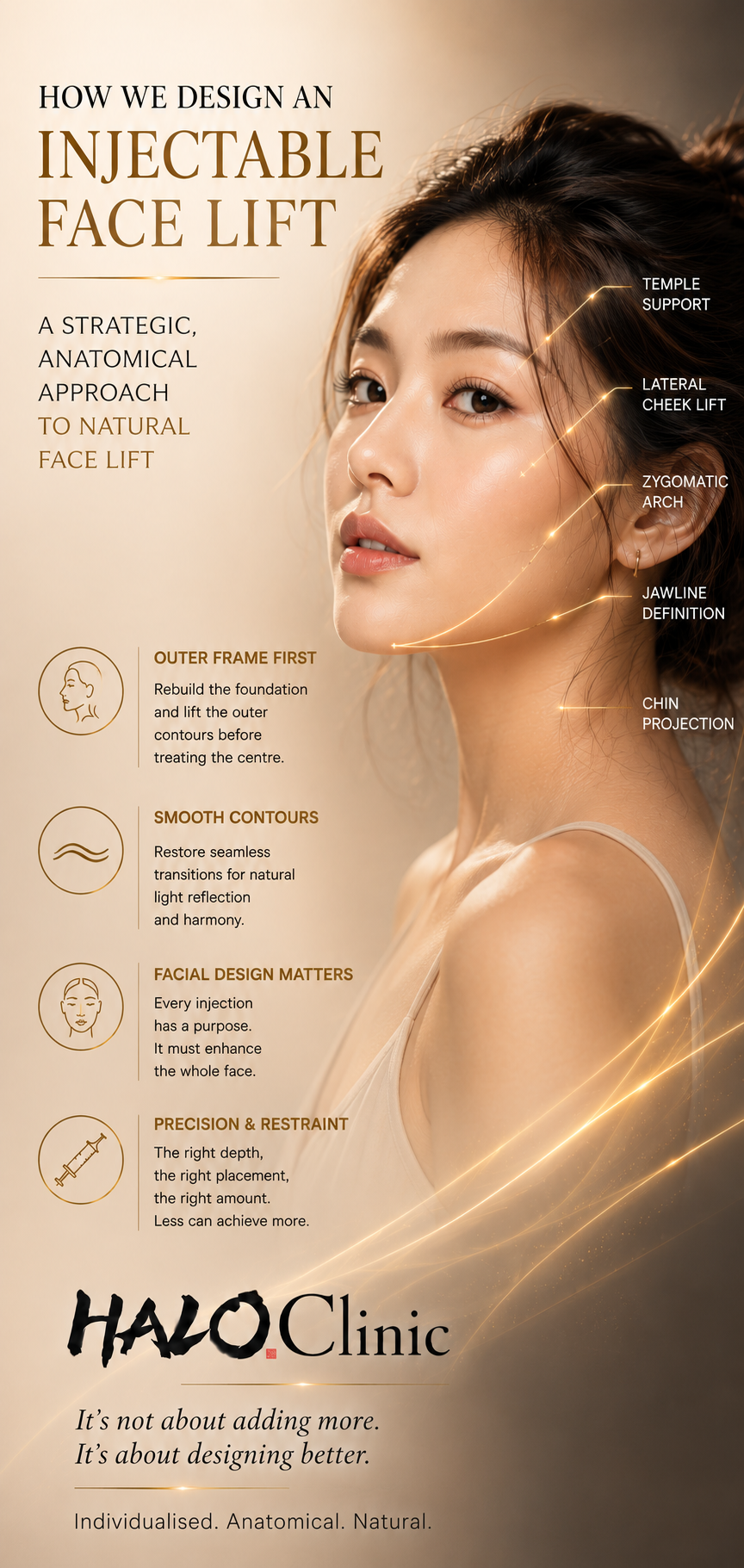
When patients think about injectable facial rejuvenation, they often focus on the areas that concern them most. Some wish to restore volume to the cheeks, others hope to soften the appearance of smile lines or improve the definition of the jawline. While these concerns are entirely understandable, treating each area individually rarely produces the most natural or balanced result.
At Halo Clinic, facial rejuvenation begins with understanding the face as a whole rather than focusing on isolated concerns. Before discussing products or deciding where to inject, the first objective is to understand how the face has changed over time. Every treatment plan is designed around restoring facial harmony, not simply correcting individual features.
An injectable face lift should therefore be viewed as a process of facial design rather than a collection of injections.
Understanding How the Face Ages
Facial ageing is a gradual structural process involving multiple anatomical layers. Over time, collagen production declines, facial fat compartments lose support and change position, retaining ligaments become less effective, skin elasticity decreases and even the underlying facial skeleton undergoes subtle remodelling.
These changes do not occur uniformly, which explains why two patients of the same age can age very differently. One patient may develop flattening through the cheeks, while another notices early jowling despite maintaining good facial volume. Others may lose definition around the jawline or experience a gradual widening of the lower face.
The visible concern is often only the final consequence of deeper structural changes. Identifying these changes is therefore far more important than deciding which injectable product to use.
The Face Should Be Treated From the Outside In
One of the fundamental principles that guides my approach to facial rejuvenation is restoring the outer frame of the face before considering the centre.
The outer frame consists of structures such as the temples, lateral cheeks, zygomatic arch, preauricular region, jawline and chin. Together, these areas form the architectural framework that supports the face and defines its overall shape. As this framework gradually weakens with age, the face begins to lose definition, the lower face may appear heavier, and facial proportions slowly change.
Many patients naturally focus on the centre of the face because this is where they notice hollows or deeper folds. However, treating these central areas first does not always address the underlying problem. If the outer frame has lost structural support, adding volume to the middle of the face may improve one feature while leaving the overall facial balance unchanged.
For this reason, I often begin by restoring support around the outer frame. Once the facial foundation has been strengthened, the overall facial proportions can be reassessed. In many patients, this alone produces a noticeable improvement in facial harmony and significantly reduces the amount of treatment required elsewhere.
Rather than asking where more volume should be added, I prefer to first ask where support has been lost.
A Beautiful Face Is Defined by Smooth Contours
When we look at a youthful and attractive face, we rarely notice individual features in isolation. Instead, we perceive the overall harmony of the face. Smooth transitions between neighbouring facial regions allow light to reflect evenly across the skin, creating an appearance that is naturally youthful, healthy and well balanced. This is one of the reasons why some people appear refreshed without having particularly prominent facial features.
As the face ages, these smooth contours gradually become disrupted. Volume loss, weakening of supporting ligaments and collagen depletion contribute to the formation of hollows, abrupt contour changes and irregular transitions between different parts of the face. Rather than seeing a single wrinkle or fold, our eyes subconsciously recognise that the facial architecture has become less harmonious.
For this reason, the objective of an injectable face lift should not be to create more projection or simply add volume to areas that appear deficient. Instead, treatment should restore continuous facial contours by recreating smooth transitions between neighbouring anatomical regions. Every injection should contribute to the overall facial shape rather than making one area stand out from the rest.
One principle I frequently apply during treatment planning is to assess how light travels across the face. When facial contours are smooth, light reflects evenly and the face appears naturally youthful. When abrupt contour changes develop, shadows become more pronounced and the face often appears older or more tired than it actually is. By restoring these smooth transitions, it is often possible to create a lifting effect that looks elegant without appearing obvious or overfilled.
Facial Design Is More Important Than Individual Injection Points
Many injectable treatments are planned by identifying individual concerns and treating them one at a time. While this approach may improve a specific area, it does not necessarily create a more attractive face.
Facial rejuvenation should instead begin by understanding how each anatomical region influences the next. The temples transition into the cheeks, the cheeks into the jawline, and the jawline into the neck. Every structure contributes to the overall facial silhouette, meaning that altering one area will inevitably influence the appearance of another.
For this reason, treatment planning should never focus solely on individual injection points. Instead, every injection should have a clear purpose within the overall facial design. Before placing any product, I ask a simple question:
Will this injection improve the harmony of the entire face?
If the answer is no, then it probably should not be performed.
Less Can Often Achieve More
One of the most common misconceptions in aesthetic medicine is that larger amounts of injectable product will produce better rejuvenation.
In reality, natural results are rarely achieved by adding more volume. They are achieved by placing the appropriate amount of product in carefully selected anatomical locations where structural support has been lost.
A well-designed treatment plan often produces greater improvement with fewer injections because every injection has been chosen to improve the overall facial architecture rather than simply filling visible deficiencies.
Patients frequently tell me they want to look refreshed without looking as though they have had cosmetic treatment. Achieving that outcome depends far more on restraint, planning and facial design than the total number of syringes used.
The Halo Clinic Philosophy
At Halo Clinic, every injectable face lift begins with a comprehensive facial assessment rather than an immediate discussion about products.
Drawing upon over 10 years of clinical experience together with extensive training in Plastic Surgery, General Surgery and Dermatology, I assess how each patient's facial structure has changed over time before developing an individualised treatment plan.
Rather than treating isolated concerns, the objective is to restore structural support, recreate smooth facial contours and improve the overall balance of the face while preserving each patient's natural identity.
Injectables are simply one of the tools available to achieve this. The true difference lies in understanding why the face has changed, where support should be restored and how each treatment contributes to the overall facial design.
When performed thoughtfully, the result should never be a face that looks obviously treated. It should simply look rested, balanced and naturally refreshed.
Frequently Asked Questions
Why don't you inject the area that bothers me first?
The area that appears to have changed is not always the area causing the problem. Restoring structural support elsewhere may produce a more natural improvement while requiring less product.
Why is the outer frame of the face so important?
The outer frame provides the structural foundation that supports facial proportions. When this support diminishes, the face gradually loses definition and balance. Rebuilding the framework first often improves the overall appearance before treating smaller details.
Why do some injectable treatments look unnatural?
Unnatural results often occur when individual areas are treated without considering the face as a whole. Excessive projection, poor contour transitions and loss of facial harmony are usually the result of treatment planning rather than the injectable product itself.
Does every patient need the same treatment plan?
No. Every face ages differently. The treatment strategy should always be tailored to the individual's anatomy, ageing pattern and aesthetic goals rather than following a standard injection protocol.
Key Takeaways
An injectable face lift begins with understanding facial ageing rather than selecting a product.
Restoring the outer frame of the face often provides the foundation for natural facial rejuvenation.
Smooth facial contours and harmonious transitions are more important than creating isolated areas of projection.
Every injection should contribute to the overall facial design rather than simply filling one concern.
Elegant results are achieved through careful assessment, anatomical understanding and thoughtful treatment planning rather than the amount of product used.
Share