


Everything You Need to Know About HIFU for Face Lifting
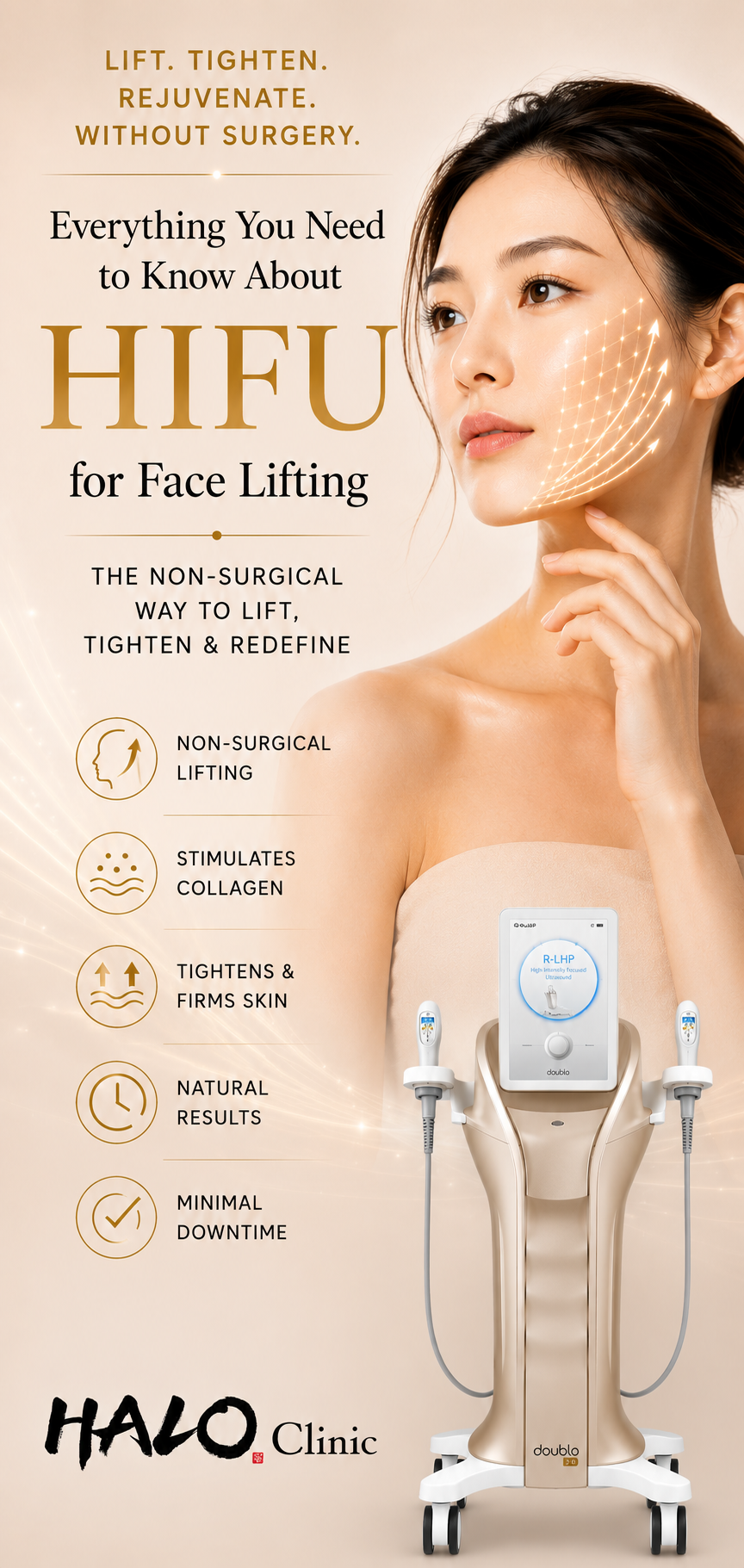
For many people, the first visible signs of ageing are subtle. The jawline becomes less defined. The cheeks begin to descend. The face appears more tired despite getting enough sleep.
Many patients want to improve these changes without surgery, which is why HIFU has become one of the most popular non-surgical lifting treatments worldwide.
But what exactly is HIFU, and can it really lift the face?
What Is HIFU?
HIFU stands for High-Intensity Focused Ultrasound. Unlike lasers or radiofrequency treatments that primarily target the skin, HIFU delivers focused ultrasound energy into specific depths beneath the surface.
This energy creates tiny thermal coagulation points that stimulate your body's natural healing response, encouraging new collagen production while tightening existing collagen fibres.
The result is gradual lifting and firmer skin over the following months.
How Does HIFU Lift the Face?
As collagen is stimulated, the skin becomes firmer and better supported.
Depending on the treatment areas, HIFU may improve:
Mild cheek sagging
Jawline definition
Early jowls
Loose skin beneath the chin
Mild neck laxity
Overall facial firmness
Because collagen remodelling takes time, improvements usually appear gradually over two to three months. The result is a refreshed appearance rather than an obvious or artificial change.
HIFU Doesn't Replace a Surgical Face Lift
This is one of the biggest misconceptions surrounding HIFU. HIFU is designed for patients with mild to moderate skin laxity who want natural improvement without surgery.
Patients with advanced skin laxity may still require surgical lifting to achieve significant repositioning of facial tissues.
The goal of HIFU is not to replace surgery, but to delay the need for it and maintain youthful facial support for as long as possible.
Who Is Suitable for HIFU?
HIFU is often suitable for patients who:
Notice early facial sagging
Want a sharper jawline
Prefer non-surgical treatments
Have mild skin laxity
Wish to stimulate collagen naturally
Want minimal downtime
The ideal candidate is usually beginning to notice facial ageing but does not yet require surgical intervention.
Why Treatment Quality Matters
Not all HIFU treatments produce the same results.
Several factors influence the outcome, including:
The quality of the HIFU device
The number of treatment shots delivered
Correct treatment depth
Energy settings
Precise treatment technique
Proper patient selection
Simply delivering more shots does not always produce better results. Likewise, inadequate treatment may fail to stimulate enough collagen for meaningful improvement.
Choosing an experienced doctor and a high-quality HIFU system is essential for achieving consistent, predictable results.
What Does HIFU Feel Like?
Most patients experience a brief sensation of warmth or tingling as the ultrasound energy is delivered. Modern HIFU systems are significantly more comfortable than earlier generations, and treatment can usually be completed without the need for significant downtime.
Most patients return to normal daily activities immediately after the procedure.
When Will I See Results?
Some patients notice a subtle tightening effect shortly after treatment. However, the main improvements occur gradually as new collagen develops.
Most patients see progressive improvement over:
6 weeks
3 months
Up to 6 months
Because your own collagen is being remodelled, the changes appear natural rather than sudden.
Can HIFU Be Combined With Other Treatments?
Absolutely.
Since facial ageing affects multiple layers of the face, HIFU is often combined with other treatments to achieve more comprehensive rejuvenation.
Depending on your individual concerns, HIFU may be combined with:
Biostimulators
Skin boosters
Wrinkle-relaxing injections
BBL
Microneedling
Exosome treatments
Each treatment targets a different layer of the ageing process, allowing for more balanced and natural-looking results.
The Halo Clinic Approach
At Halo Clinic, HIFU is never performed as a one-size-fits-all procedure. Dr Delong Zeng has over 10 years of clinical experience with extensive training in Plastic Surgery, General Surgery, and Dermatology. Every HIFU treatment begins with a careful assessment of facial anatomy, skin laxity, collagen loss, and the underlying causes of ageing.
We use the Hironic New Doublo 2.0 HIFU, an advanced Korean HIFU system designed to deliver consistent, precise energy at multiple treatment depths. Rather than focusing solely on the number of shots, we customise the treatment based on your facial structure, skin thickness, and lifting goals to maximise both safety and results.
Frequently Asked Questions
How long do HIFU results last?
Most patients enjoy improvements for approximately 12 to 18 months, depending on age, skin condition, and lifestyle. Regular maintenance treatments can help preserve results.
Is HIFU painful?
Modern HIFU devices are significantly more comfortable than older generations. Most patients describe the treatment as tolerable, with brief sensations of warmth or tingling.
Is there any downtime?
Downtime is minimal. Mild redness or slight tenderness may occur temporarily, but most patients return to normal activities immediately after treatment.
How many HIFU treatments do I need?
Many patients achieve noticeable improvement after a single treatment. Maintenance sessions may be recommended depending on your skin condition and long-term goals.
Key Takeaways
HIFU is a non-surgical treatment that stimulates collagen using focused ultrasound energy.
It is most suitable for mild to moderate facial sagging and skin laxity.
Results develop gradually over several months as collagen remodels.
Treatment quality depends on the device, technique, treatment planning, and doctor experience.
Personalised HIFU treatment often produces more natural and longer-lasting results.
Share