


Skin Tightening vs Face Lifting: What's the Difference?
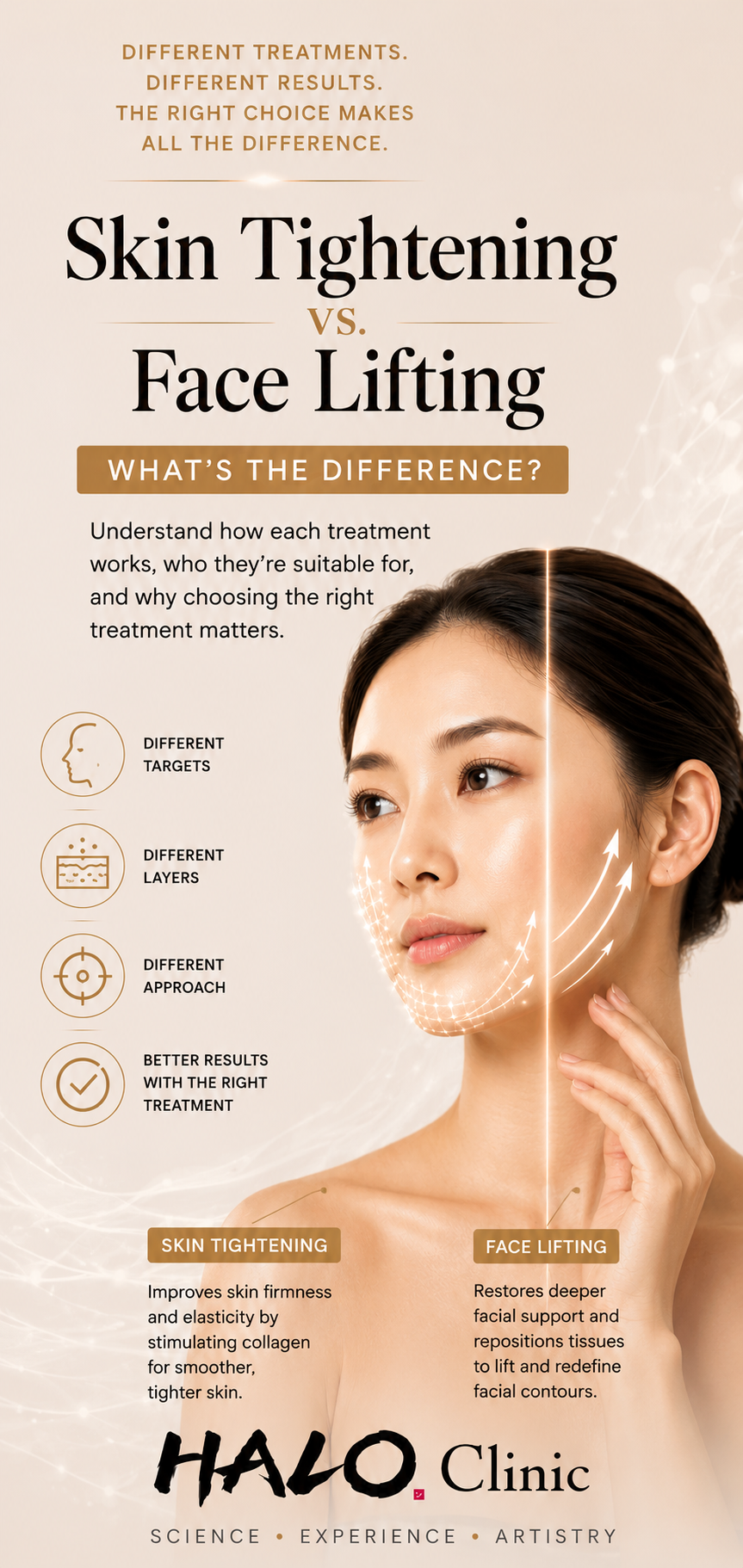
One of the most common misconceptions in aesthetic medicine is that skin tightening and face lifting are the same thing.
While both treatments aim to create a younger-looking appearance, they target different layers of the face and solve different problems. Understanding the difference can help you choose the treatment that will give you the best and most natural-looking results.
What Is Skin Tightening?
Skin tightening treatments improve the firmness and elasticity of the skin by stimulating collagen production.
As collagen levels increase over time, the skin becomes:
Firmer
Smoother
More elastic
Better supported
Patients often notice improvements in skin texture and mild tightening over several months.
Skin tightening is most suitable for patients with:
Mild skin laxity
Early signs of ageing
Fine wrinkles
Reduced skin firmness
Examples include HIFU, radiofrequency treatments, microneedling, collagen-stimulating injectables, and certain laser treatments.
What Is Face Lifting?
Face lifting focuses on restoring facial support and improving sagging caused by deeper structural changes.
As we age, several things happen simultaneously:
Fat compartments shrink and descend.
Facial ligaments weaken.
Bone structure gradually changes.
Skin loses collagen.
These changes cause the cheeks to descend, the jawline to soften, and jowls to develop. Simply tightening the skin cannot fully correct these deeper structural changes.
Face lifting aims to reposition or support these deeper tissues to restore youthful facial proportions.
Why Skin Tightening Alone Isn't Always Enough
Many patients believe that loose skin is the primary cause of facial ageing. In reality, skin is only one layer of the ageing face. If the cheeks have descended or facial support has weakened, tightening the skin alone may produce only subtle improvements.
Similarly, replacing volume without improving skin quality may also produce incomplete results. The best outcomes often come from treating the specific layer responsible for the ageing process.
Which Treatment Is Right for You?
This depends entirely on what has changed.
If your main concern is:
Loose, thin skin
Skin tightening may be the priority.
Loss of facial support
Lifting treatments may be more appropriate.
Hollow cheeks
Volume restoration may be needed.
Multiple signs of ageing
Many patients benefit from combining several treatments rather than relying on just one.
Can Non-Surgical Treatments Lift the Face?
Yes, but it's important to understand what "lifting" means. Modern non-surgical treatments can improve facial contours, strengthen supporting structures, and stimulate collagen production, resulting in a noticeable lifting effect for carefully selected patients.
However, they cannot replicate the degree of lifting achieved by surgical face-lift procedures in patients with significant skin laxity. The goal is to achieve natural-looking rejuvenation while avoiding an overfilled or artificial appearance.
Why Correct Diagnosis Matters
Many patients seek treatment for the wrinkle or fold they see in the mirror. However, the visible wrinkle is often not the actual problem.
For example:
Deep nasolabial folds may be caused by descending cheeks.
Marionette lines may result from loss of facial support.
Jowls may develop because of ligament weakening rather than excess skin.
Treating the symptom rather than the underlying cause often leads to disappointing results. Accurate diagnosis is therefore one of the most important steps in facial rejuvenation.
The Halo Clinic Approach
At Halo Clinic, treatment begins with understanding why your face has changed, not simply identifying where it has changed.
Dr Delong Zeng has over 10 years of clinical experience and extensive training in Plastic Surgery, General Surgery, and Dermatology. Every consultation includes a detailed assessment of facial anatomy, skin quality, collagen loss, facial support, volume changes, and overall facial balance.
Rather than relying on a single treatment, personalised plans may combine collagen stimulation, HIFU, biostimulators, skin boosters, fillers, wrinkle-relaxing injections, or other technologies to address the underlying causes of facial ageing.
Our philosophy is simple: treat the right layer, not just what you can see.
FAQ
Is skin tightening the same as a face lift?
No.
Skin tightening improves the firmness and quality of the skin, while face lifting restores support to the deeper facial structures responsible for sagging.
Can HIFU replace a surgical face lift?
HIFU can produce noticeable lifting and tightening in suitable patients with mild to moderate ageing. However, it cannot achieve the same degree of lifting as surgery in patients with significant skin laxity.
Why doesn't tightening my skin remove my smile lines?
Smile lines are often caused by descending cheek fat and loss of facial support rather than loose skin alone.
Treating only the skin may not address the underlying cause.
Is combining treatments better?
For many patients, yes.
Ageing affects multiple layers of the face, so combining treatments often produces more balanced, natural-looking, and longer-lasting results.
Key Takeaways
Skin tightening and face lifting are not the same treatment.
Skin tightening improves collagen, firmness, and skin quality.
Face lifting restores deeper facial support and contours.
The best treatment depends on the cause of facial ageing rather than the wrinkle itself.
Personalised treatment plans often produce the most natural-looking results.
Share