


Biostimulators vs Fillers: What's the Difference?
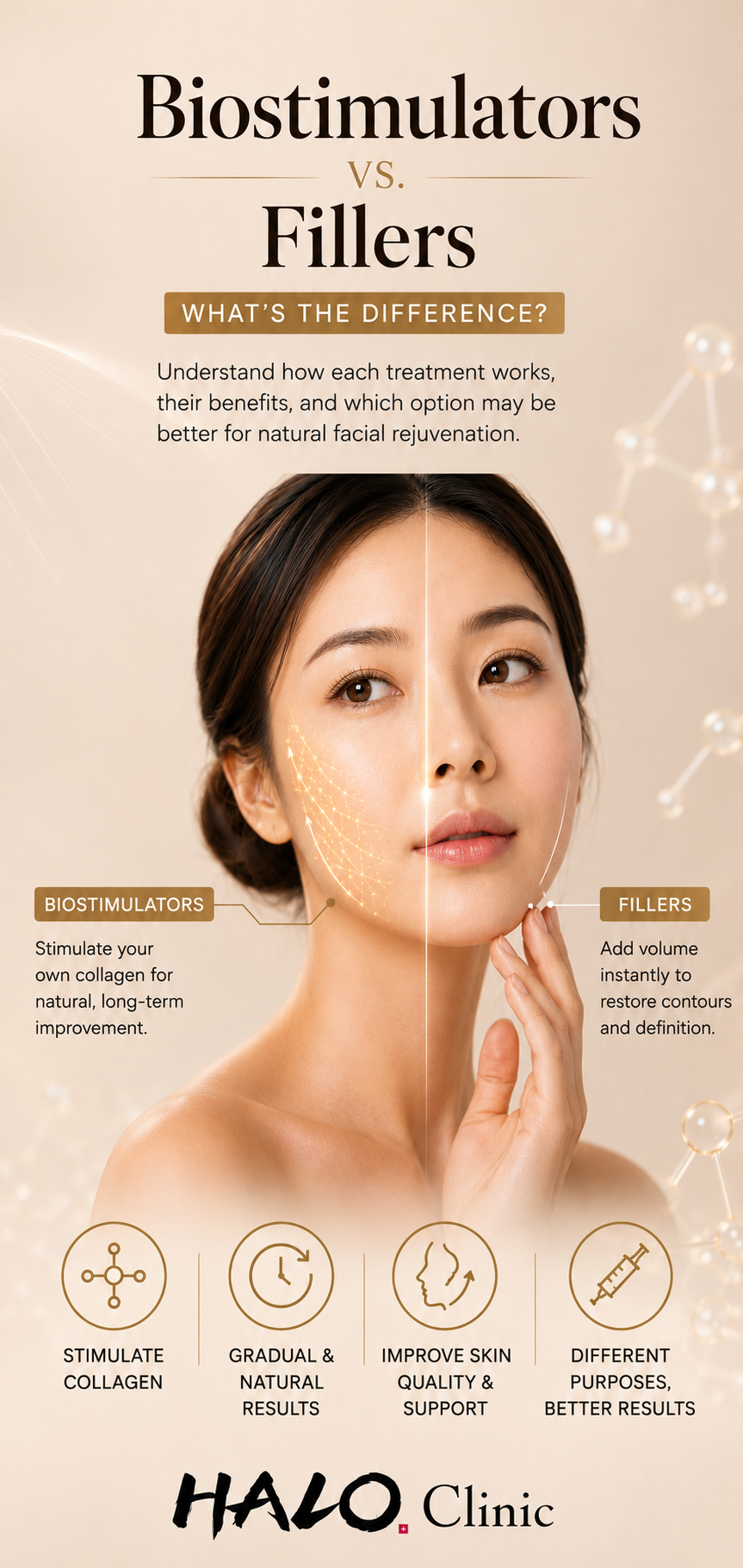
Many patients assume that all injectable treatments work the same way.
In reality, biostimulators and traditional dermal fillers have completely different purposes.
While both can improve signs of ageing, they achieve their results through different mechanisms. Understanding these differences can help you choose the treatment that best suits your goals.
What Are Dermal Fillers?
Traditional dermal fillers are most commonly made from hyaluronic acid (HA), a naturally occurring substance found in the skin.
When injected, fillers provide immediate volume by physically occupying space beneath the skin.
They are commonly used to:
Restore facial volume
Improve facial contours
Fill deeper folds
Enhance facial features such as the chin, nose, lips and jawline
One of the biggest advantages of fillers is that results are visible immediately after treatment.
What Are Biostimulators?
Unlike fillers, biostimulators do not primarily work by adding volume.
Instead, they stimulate your body's own collagen-producing cells (fibroblasts) to gradually rebuild collagen over the following months. Rather than simply filling an area, they improve the skin's underlying support and structure.
This gradual process often produces a softer, more natural-looking result that continues to improve over time.
Immediate Results vs Gradual Improvement
This is one of the biggest differences between the two treatments.
Fillers
Immediate results
Ideal when volume replacement is needed quickly
Results gradually decrease as the filler is broken down
Biostimulators
Gradual improvement over several weeks to months
Stimulate natural collagen production
Results continue to improve over time
Often provide longer-lasting skin quality improvements
Patients should understand that biostimulators require patience, but many appreciate the natural progression of their results.
Which Looks More Natural?
Both treatments can produce natural-looking results when performed correctly.
However, because biostimulators stimulate your own collagen rather than relying solely on injected volume, they often create improvements that are more subtle and progressive.
Friends and family may notice that you look fresher, healthier, or more youthful without being able to identify exactly what has changed.
The final outcome depends not only on the product used, but also on the treatment plan and the experience of the injector.
Can Fillers Cause an Overfilled Appearance?
Fillers themselves are not the problem.
Problems usually occur when:
Too much filler is injected
The wrong areas are treated
The facial ageing process is not properly assessed
Volume is repeatedly added without addressing collagen loss or facial support
When used appropriately, fillers remain an excellent treatment option for many patients.
Why Many Patients Are Choosing Biostimulators
As our understanding of facial ageing has evolved, treatment goals have also changed.
Rather than simply filling lines and folds, many patients now prefer treatments that improve the overall quality and strength of their skin.
Biostimulators can help:
Improve skin firmness
Enhance skin quality
Increase collagen production
Support facial structure
Produce gradual, natural-looking rejuvenation
For suitable patients, they may reduce the amount of filler required over time.
Every Face Ages Differently
Some patients primarily lose collagen.
Others lose facial fat.
Some develop skin laxity.
Many experience a combination of all three.
This is why there is no universal "best" injectable treatment.
The right treatment depends on understanding which layers of the face have changed and selecting the appropriate solution.
The Halo Clinic Approach
At Halo Clinic, injectable treatments are tailored to the individual rather than following a one-size-fits-all approach.
Dr Delong Zeng has over 10 years of clinical experience with extensive training in Plastic Surgery, General Surgery, and Dermatology. His approach begins with a detailed assessment of facial anatomy, collagen loss, facial support, and volume changes before recommending treatment.
Rather than simply adding volume, the focus is on restoring facial harmony while maintaining natural movement and proportions.
For many patients, the best results are achieved using a combination of treatments. This may include biostimulators, fillers, skin boosters, wrinkle-relaxing injections, HIFU, or other collagen-stimulating procedures depending on your individual needs.
FAQ
Which lasts longer, fillers or biostimulators?
Both treatments vary depending on the product used and the area treated. In general, biostimulators often provide longer-lasting improvements because they stimulate your body's own collagen production.
Are biostimulators better than fillers?
Neither treatment is universally better. Fillers are excellent for restoring volume and creating immediate results, while biostimulators focus on improving collagen, skin quality, and long-term facial support. The best treatment depends on your individual concerns.
Can fillers and biostimulators be combined?
Yes. Many patients benefit from combining both treatments. Fillers can restore specific areas of volume, while biostimulators improve overall skin quality and collagen production.
Which treatment is more suitable for younger patients?
Younger patients who require facial contouring or feature enhancement may benefit from fillers. Patients beginning to notice collagen loss or early signs of ageing may be suitable candidates for biostimulators, depending on their assessment.
Key Takeaways
Fillers provide immediate volume by replacing lost tissue.
Biostimulators work by stimulating your body's own collagen production.
Both treatments have important roles in facial rejuvenation.
The most natural-looking results come from selecting the right treatment for the right patient.
An experienced injector should assess facial anatomy and the causes of ageing before recommending treatment.
Share